Talk about Dots? Absolutely!
By Cindy Aossey
 Quick looks, sometimes called dot talks, are a special kind of number talk in which students are briefly shown an image of a quantity, and students are prompted to determine the total.
If students are new to number talks, we recommend starting with dots rather than a computation task. The overall structure of the experience is the same as a number talk in that (1) the teacher provides a prompt, (2) students have individual think time, (3) the teacher collects responses, and (4) the teacher collects and annotates strategies. Students use established hand signals to indicate their readiness to share, agreement, etc., and the teacher weaves in partner talk to offer more thinking time and discourse as needed. (See related posts for more information about number talks). Talking about dots allows students to learn and grow more comfortable with the steps of a number talk, while also building mental images of numbers and how they can be composed and decomposed.
In their book Making Number Talks Matter: Developing Mathematical Practices and Deepening Understanding, Grades 3-10 (2015), the authors, Cathy Humphreys and Ruth Parker, recommend starting with a simple dot arrangement such as the figure below. Give it a try! Give yourself a quick peek at the image. How many dots are there? How did you figure it out?
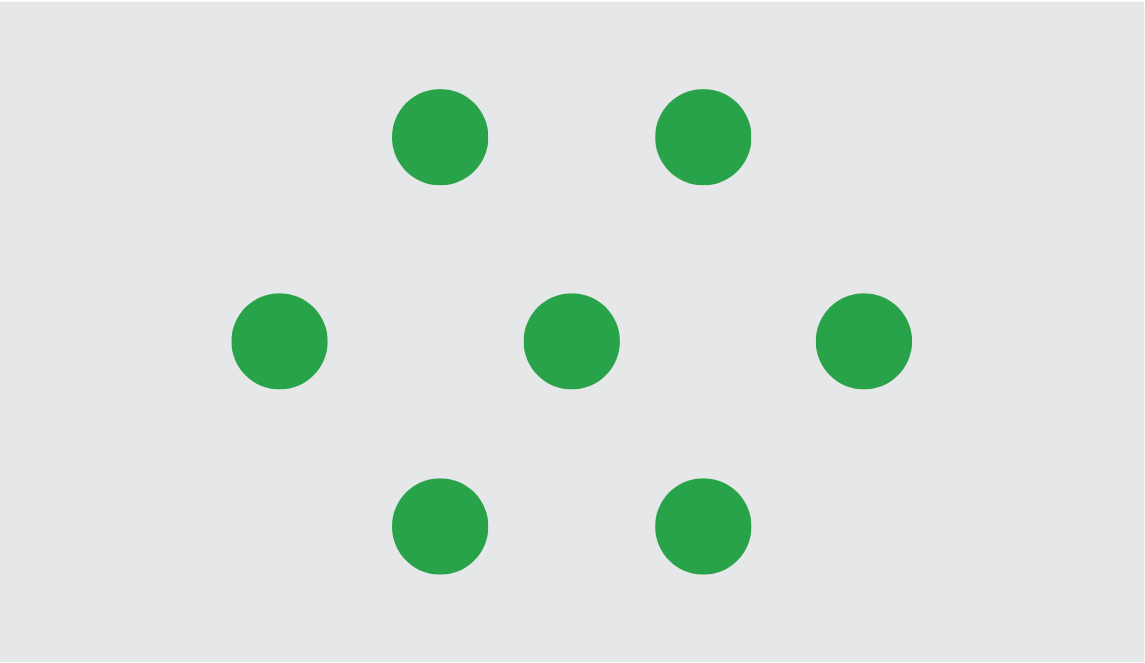
To encourage students to attend to structure and use groups, the dot image should be shown briefly (about ½ second). Students can be given additional, slightly longer looks (about 1-2 seconds) as needed. Note - young learners (typically Kindergarten and early Grade 1) may still be developing their understanding of counting principles, including cardinality. For children at this age, you might start by showing the image briefly (1-2 seconds), ask students to mentally imagine the dots, then display the dot image so that students have as long as they need to count the quantity. While discussions with older students should focus on non-count-by-one strategies, discussions with young learners should include counting by ones, with discussion of how students track the dots and that the last number of the count is the size of the collection.
You will likely find that students of all ages are eager to respond. Most likely, the class will quickly reach consensus that the number of dots is 7. But then something really interesting can happen as you start to collect responses. I bet you and your students will be amazed at how many different strategies there are! At this point in the dot talk, I like to display the dot image so students can refer to it as they share their strategies and listen to the strategies of others.
See below for a sampling of the responses you might receive from older students and how you might annotate each response. For each, imagine what a student might have said and how they might have gestured to communicate their thinking. Alternatively, especially for younger students, a teacher might choose to have a recording page consisting of multiple copies of the prompt so that each response can be recorded.
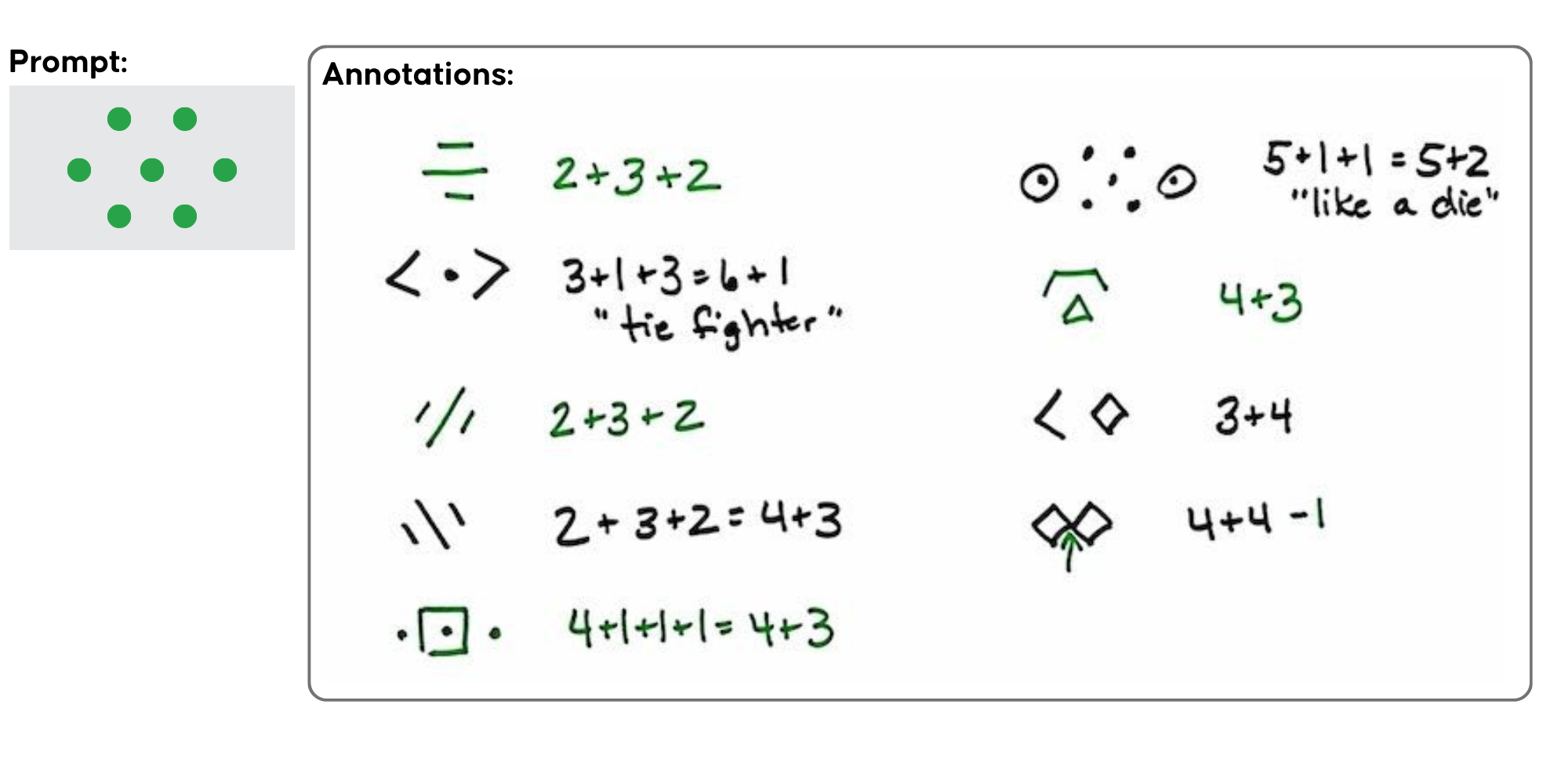
Was your strategy recorded above? If not, how would you annotate your own strategy? Can you think of another strategy not shown?
Through this experience, students are learning to listen to and learn from each other - an essential aspect of number talks. They are learning to look for structure and think about how a quantity is composed. They are building mental images of numbers. For example, they are learning that 3 can be visualized as three dots in a horizontal line, a diagonal line, or in a triangle structure. They are seeing how a simple visual and an expression can be used to communicate the structure they are seeing. And finally, they are building their comfort and confidence with the number talk routine.
Young students will benefit from frequent experiences with small quantities in different arrangements. Older students can move quickly to much larger quantities with arrangements that encourage place value and/or multiplicative reasoning. Include images that can be more easily quantified by mentally “moving” dots or “pretending” dots, then adjusting - these create foundations for flexible calculation strategies.
Don’t limit yourself to dots! Use your classroom manipulatives to create concrete representations of quantity. Contextual images, such as eggs arranged in cartons, grocery store shelves, chairs set around tables, or an array of window panes, help students notice multiplicative structures all around them. See the chart below for more suggestions.
| Category & Example(s) | Descriptor & Prompt(s) | Purpose & Anticipated Strategies | Resources |
|---|---|---|---|
|
Regular Dice Patterns
Domino Pattern 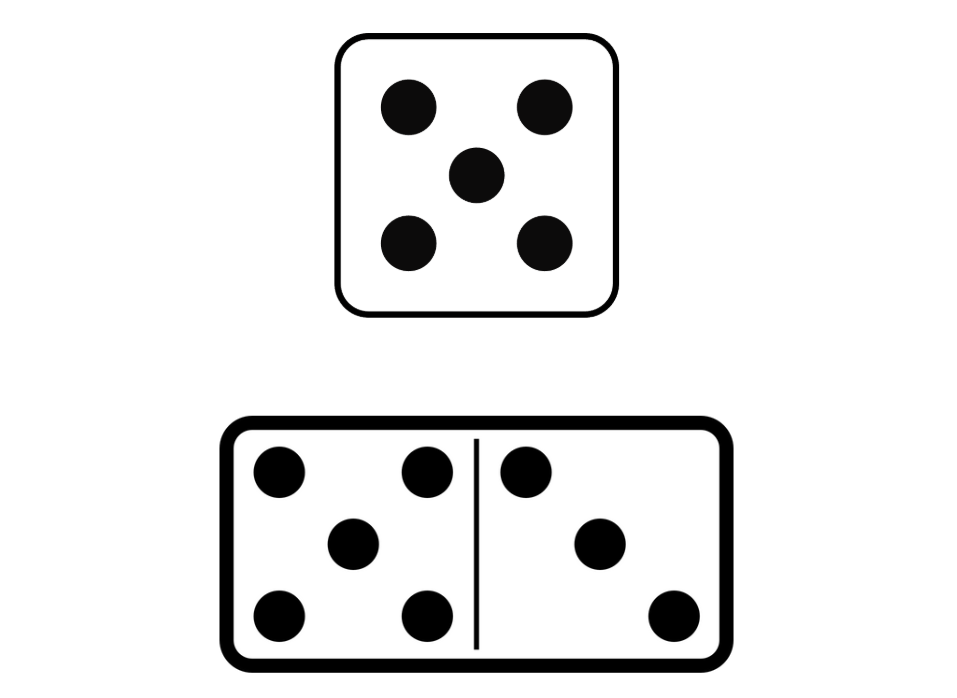
|
Questions to Ask How many dots? How do you know? |
Subitizing - instantly knowing the size of a group. Cardinality - connecting the “name” of the image (e.g., “this is a five”) to the experience of counting (“one, two, three, four, five”) helps young learners to understand that the last number of the count names the quantity of a collection. Early addition - sums with addends up to 9. |
Virtual Resources: Domino Talks |
|
5 Frames 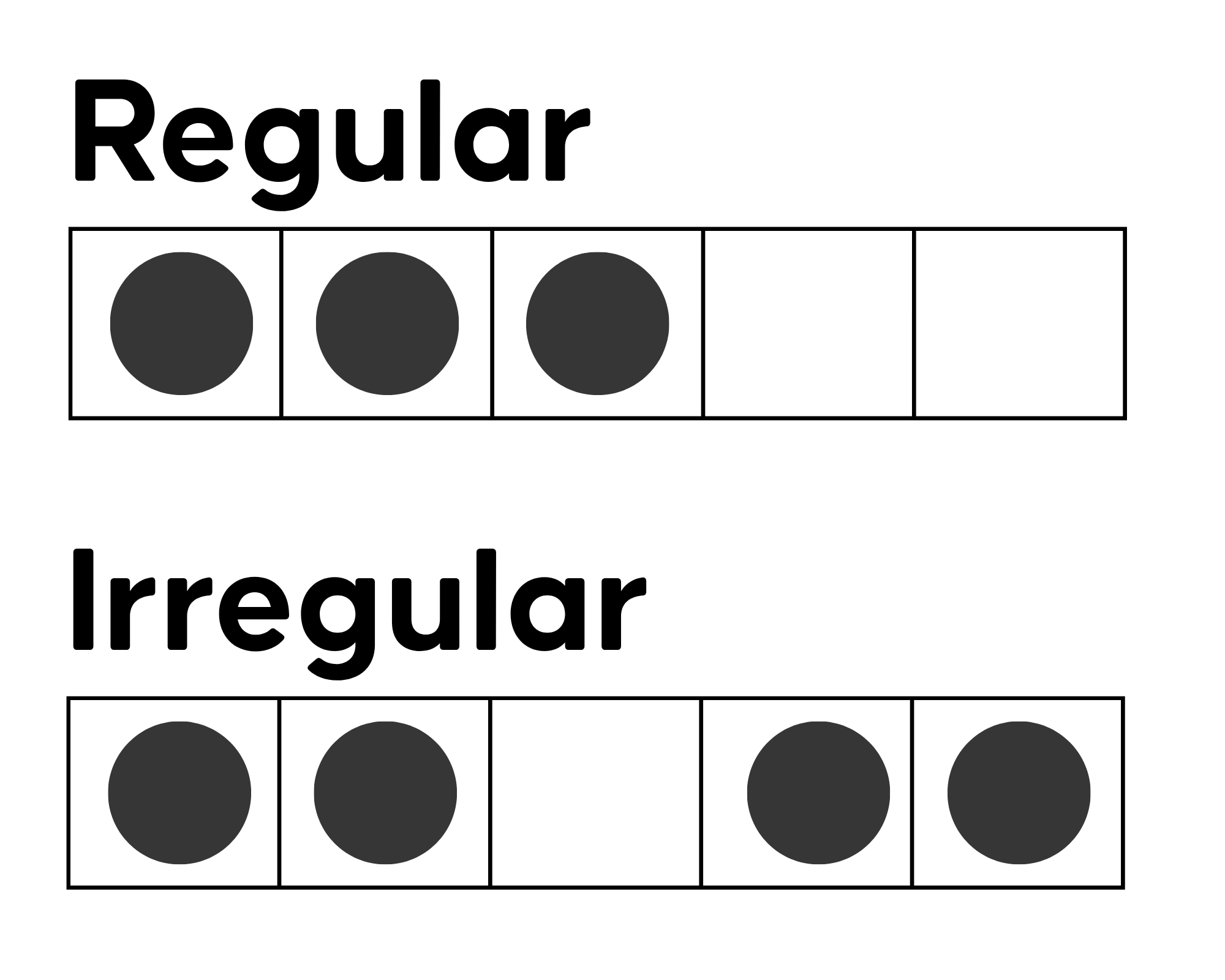
|
Regular - dots placed consecutively from left. Irregular - dots placed in any space. Questions to Ask How many dots? How many empty spaces? How do you know? |
Subitizing small quantities. Foundational to developing fluency within 5. For example, in the bottom 5 frame, students might reason “I see 2 and 2 - that’s 4, and 1 more is needed to have 5.” |
|
|
Irregular Dot Arrangements 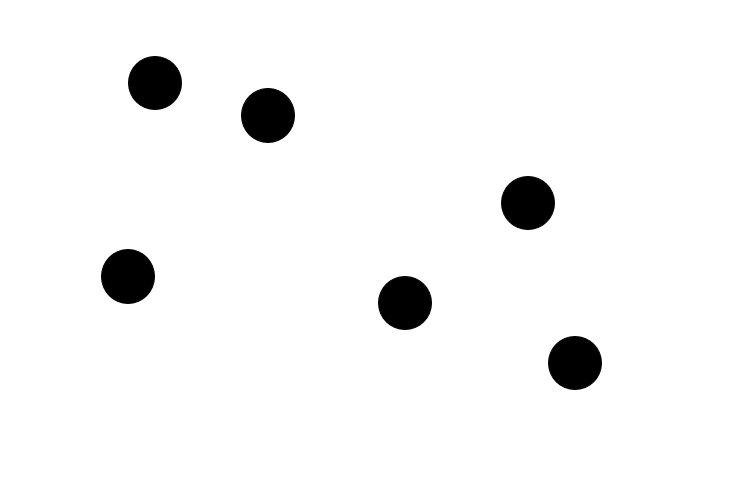
|
Small quantities (up to 8 or so) in a scattered arrangement, often with implied or subtle groupings. Questions to Ask How many dots? How do you know? How are the dots arranged? |
Subitizing small quantities. Foundational for developing fluency within 10. For example, in this image, a student might see this as 3 & 3 to determine there are 6 dots. |
Virtual Resources: Visual Number Talks 100 Subitizing Slides & 10 Challenge Patterns - Steve Wyborney's Blog |
|
Organized Dot Arrangements (within 20) 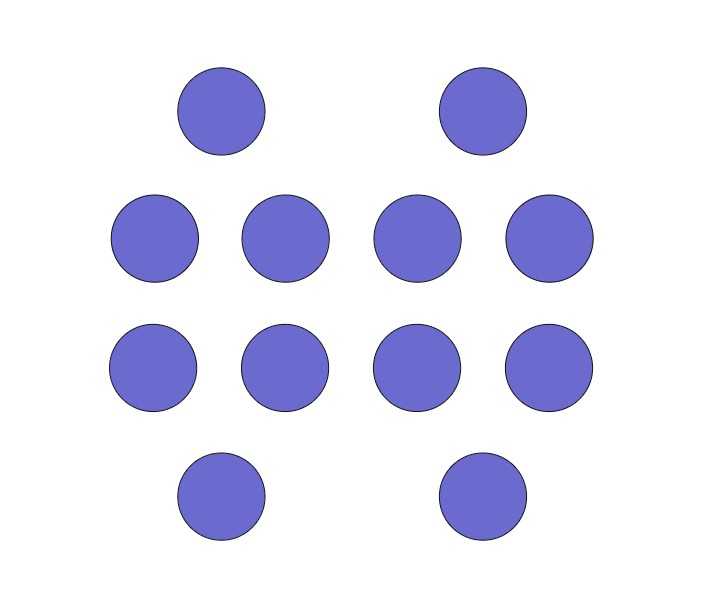
|
Dots (or other small graphics or items) arranged in structures that encourage calculation shortcuts, such as by using symmetry, dot dice arrangements, patterns, equal groupings, arrays, “missing” pieces, etc.
Questions to Ask How many dots? How do you know? How are the dots arranged? |
Subitizing small quantities. Addition within 20 Mentally “moving” or “pretending” dots to create calculation shortcuts. Notice and use symmetry. For example, when considering this image, a student might see the left half as 4+2 = 6, then double to determine there are 12 dots. |
Virtual Resources: Visual Number Talks 100 Subitizing Slides & 10 Challenge Patterns - Steve Wyborney's Blog |
|
10 Frames 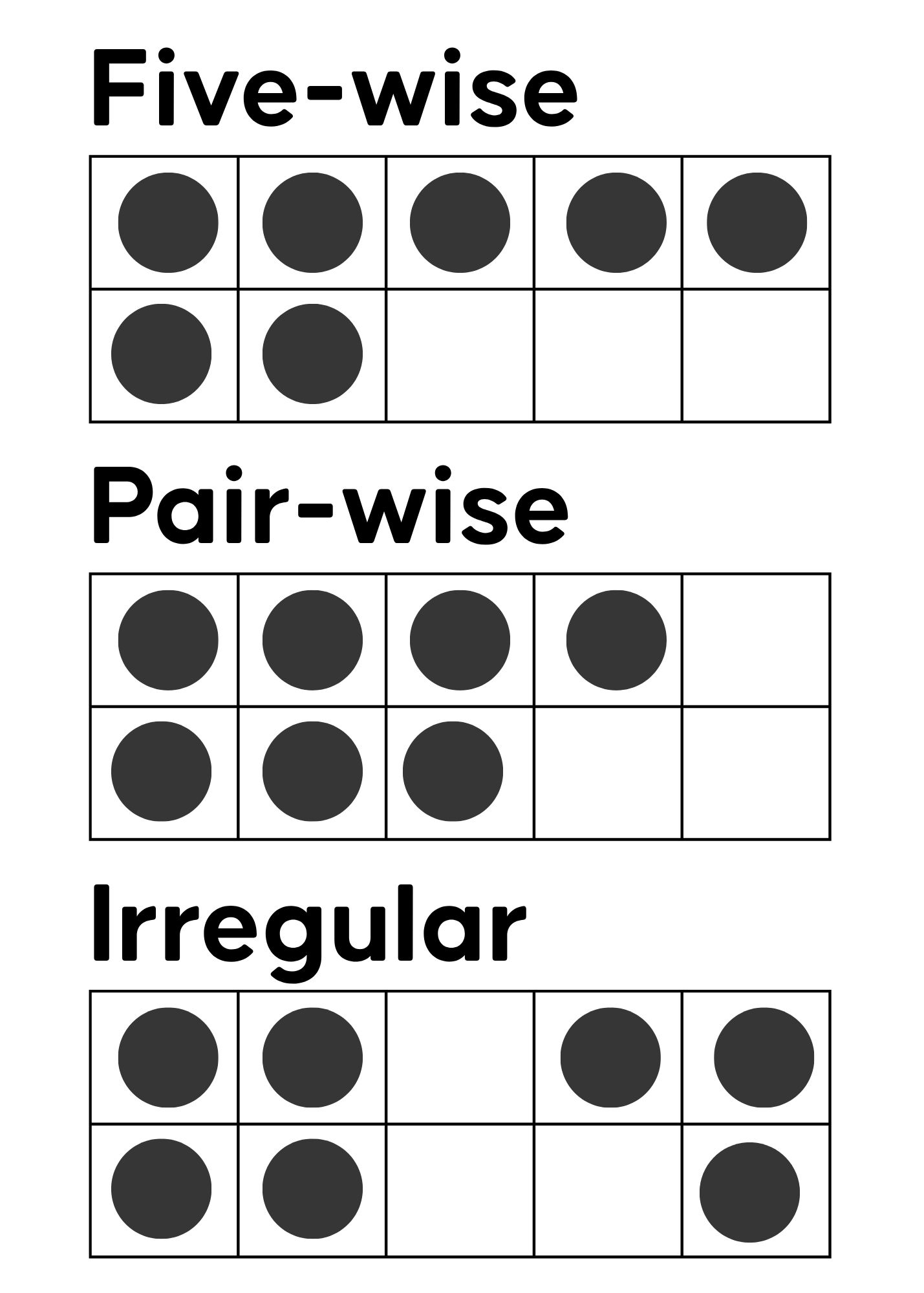
|
Five-wise - top row is filled left to right before any dots placed on bottom row. Pair-wise - top and bottom row are filled as evenly as possible. Irregular - dots placed in any arrangement. Questions to Ask What do you see? How many dots on the top row? How many dots on the bottom row? How many dots in all? How many empty spaces? How many dots to make 10? |
Foundational to developing fluency within 10. Standard structures (5+ and doubles/near doubles) for numbers within 10 as well as combinations of 10. For example, in the bottom two frames shown, a student can “see” that 7 is composed of 4 & 3 and is 3 away from 10. |
|
|
Rekenrek (also called Bead Rack) Structures within 10 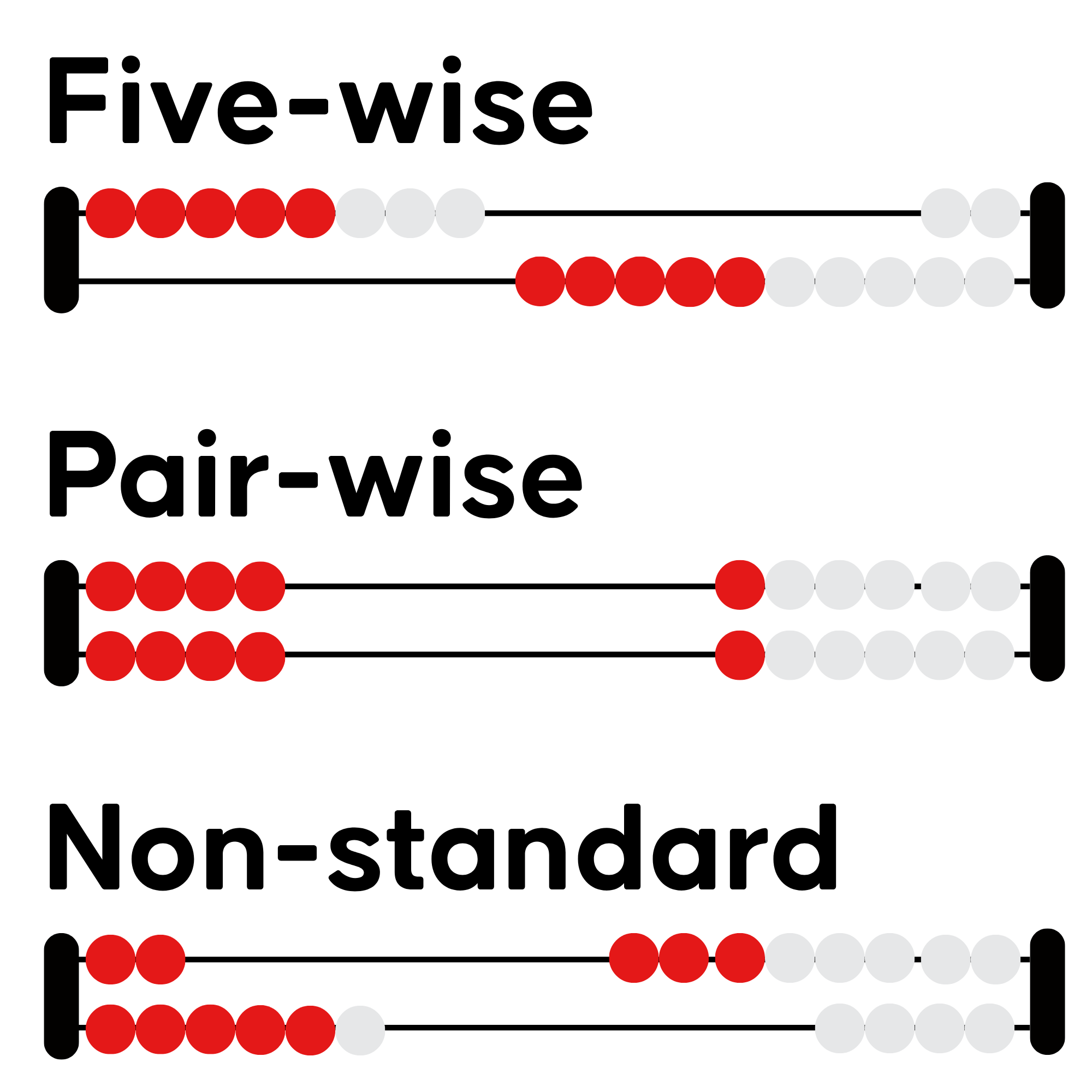
|
Instantly recognize quantities within 10 arranged either five-wise (one row) or pair-wise (two rows shown as a double or near double). Be able to quickly determine the total of a non-standard arrangement without counting by ones. Questions to Ask How many red beads? How many white beads? How many beads in all? |
Foundational to developing fluency within 10. Connect knowledge of 10-frame structures to bead rack structures. Students should also be learning to quickly build quantities on a bead rack with “one-push” per row. |
Math Hub Post: Introducing the Rekenrek |
|
Rekenrek Structures within 20 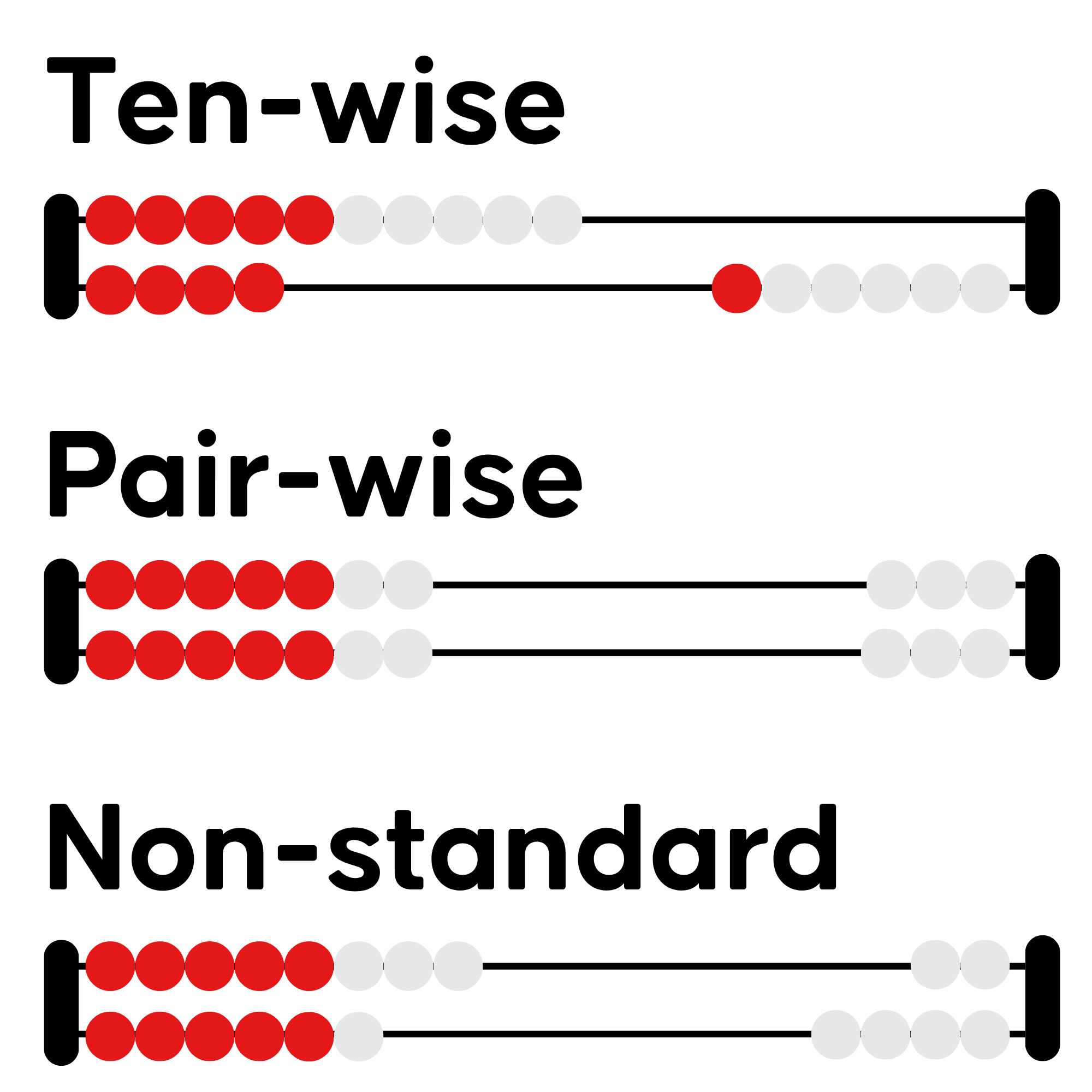
|
Instantly recognize teen numbers arranged either ten-wise or pair-wise structures. Be able to quickly determine any total of a non-standard arrangement without counting by ones. |
Understand that teen numbers are composed of a 10 and some more ones. Use the structure of small doubles and near doubles to determine large doubles (e.g., see 7+7 as composed of 2 groups of 5 and 2 groups of 2, so it’s 10+4 = 14). Foundational to developing fluency within 20. |
Math Hub Post: Introducing the Rekenrek |
|
Pair of 10 Frames 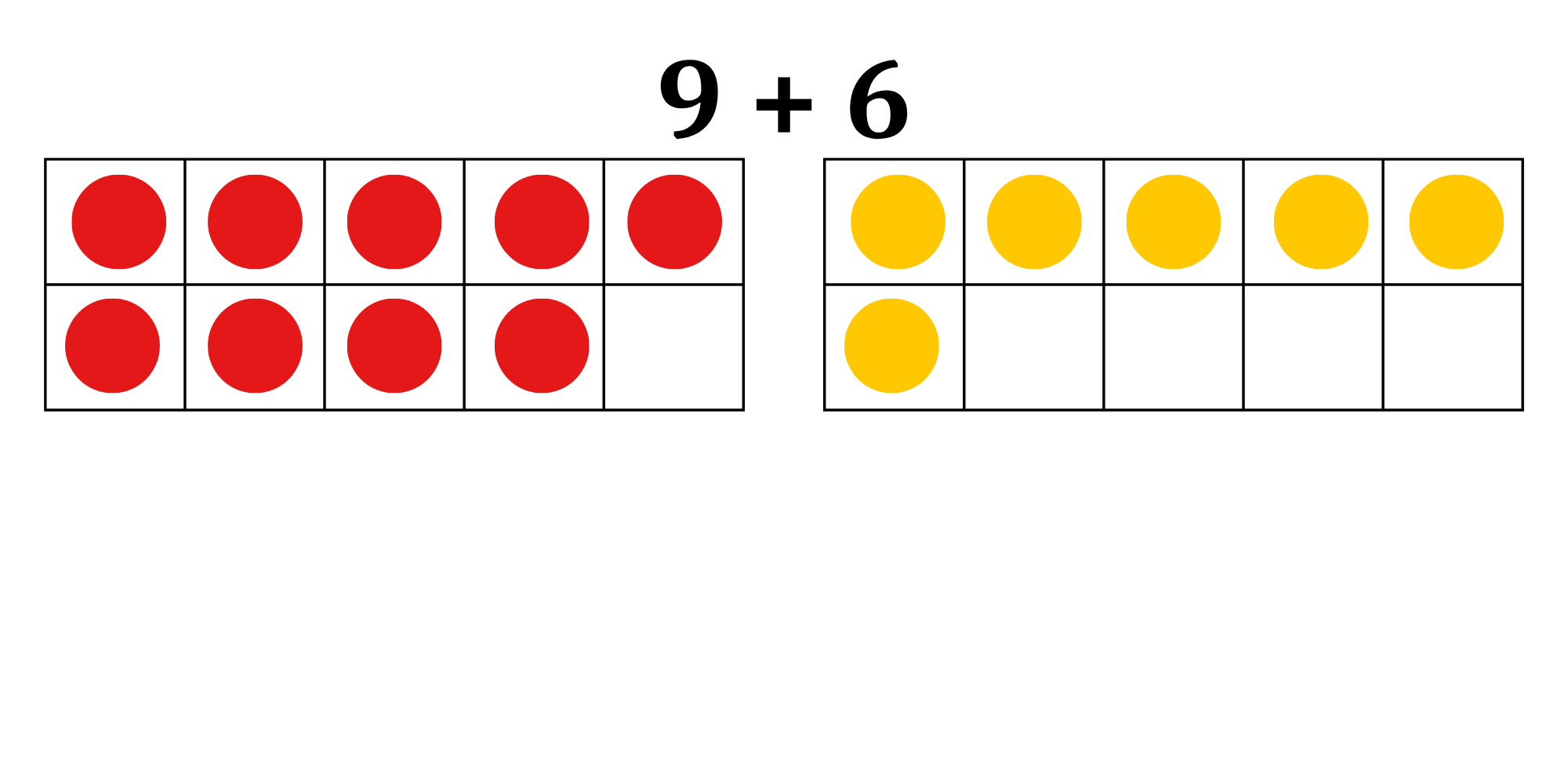
|
Find the total of any two partially filled or filled ten-frames. Questions to Ask What do you see? How many dots on the first frame? On the second? How many dots in all? How do you know? |
Foundational to developing fluency within 20. Develop mental strategies such as “make-a-ten”, “pretend-a-ten”, and near doubles. For example, as illustrated here, a student might mentally move one dot from the 6 to the 9 to create the equivalent but easier fact 10+5. |
Virtual Resources: Addition within 20 using Ten Frames |
|
Mini Ten-Frame Cards 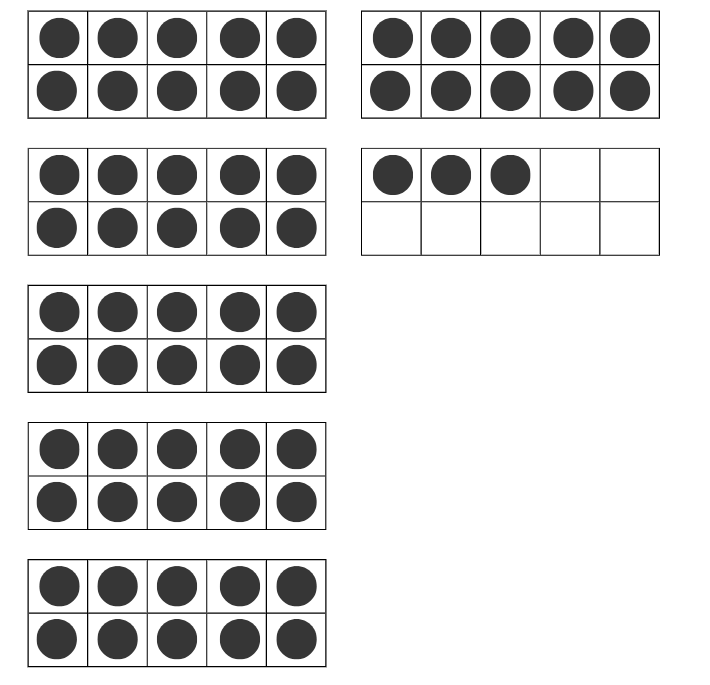
|
Represent two-digit numbers using filled ten frames and one partially filled ten-frame. Questions to Ask How many dots? How many are in the partial frame? How many dots if I remove this partial frame? How many dots do we need to fill in the partial frame? If we do that, how many dots will we have in all? How many dots if I remove/add a filled ten-frame? What if I add 3 filled ten frames? Extend to posing addition & subtraction tasks with ten frames. |
Understand that a two-digit number is composed of multiple tens and some more ones. Identify nearby multiples of ten (“friendly numbers”) and how many dots need to be added or removed to reach each. Foundational to computation strategies and rounding. Add or subtract a ten or multiple of ten. |
Virtual Resources: Addition & Missing Addend Tasks within 100 Virtual Resources: Ten Frame Subtraction Virtual Resources: Early Addition Strategies within 100: Mini Ten Frames |
|
10 Row Rekenrek (beadrack) 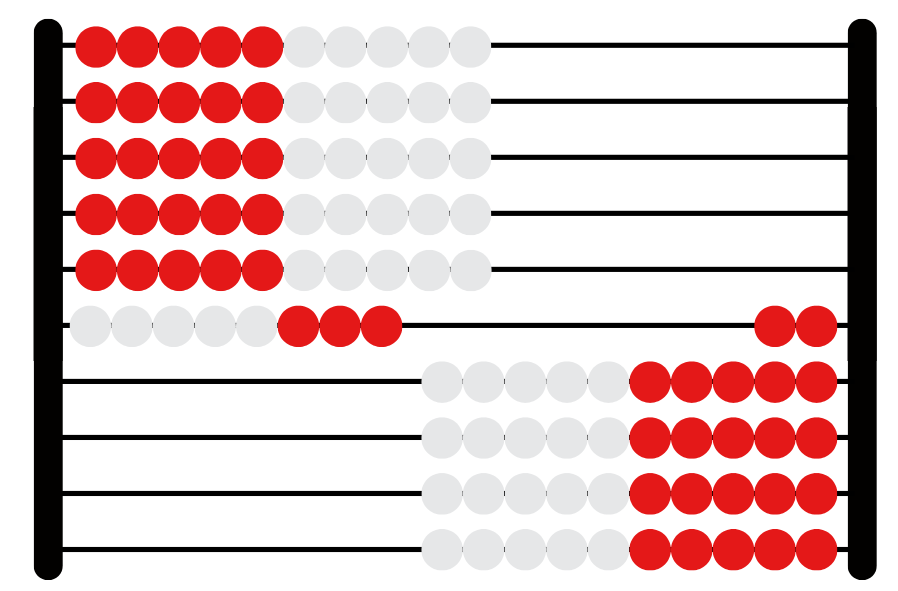
|
Represent two-digit numbers using rows of 10 beads and one partial row. Questions to Ask How many beads? How many beads are there in this partial row? How many beads in all if I remove the beads from this row? How many beads do we need to fill in the partial row? If we do that, how many beads will we have in all? How many beads if I remove/add a full row? What if I add 3 full rows? |
Connect understandings developed using mini ten-frames to a different visual.
Understand a two-digit number is composed of multiple tens and some more ones. Identify the nearby multiples of ten (“friendly numbers”) and how many dots need to be added or removed to reach each. Add or subtract a ten or multiple of ten. |
|
|
Multiplicative Images within 100 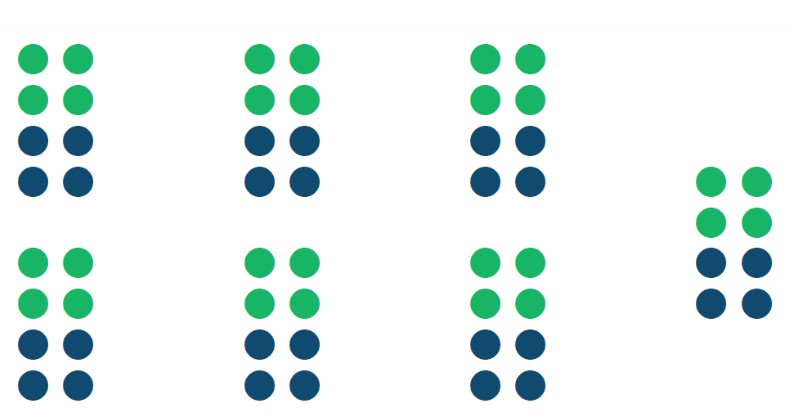
|
Quantities are arranged in equal groups using positioning, and perhaps color, to encourage students in using properties of multiplication and relating to easier or known facts. Questions to Ask What do you see? How many? How do you know? How are the arranged? How many groups? How many in each group? |
Foundational to developing fluency with multiplication within 100. Students use properties of operations (commutative, associative, distributive) to determine products of single-digit factors. For example, in the image shown, a student might determine 7×8 by determining the number of green dots (7×4 = 28) then doubling to get 56, or solve by thinking 3×8 is 24, double to determine that 6×8 is 48, and add one more group of 8 to find that 7×8 is 56. |
Virtual Resources: Multiplicative Images Virtual Resources: Sequencing Quick Looks - Doubling Strategies |
|
Tile Configurations 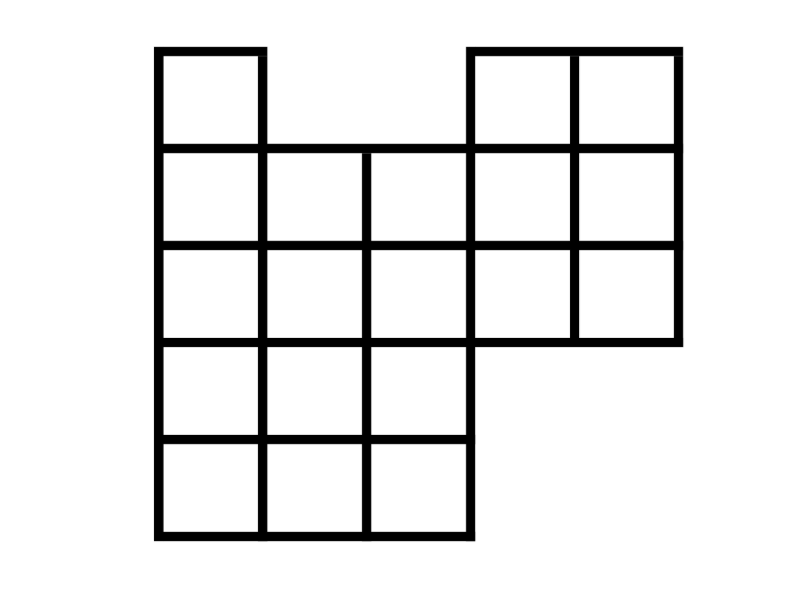
|
Students are prompted to determine how many square tiles they would need to build the figure.
Depending on the image complexity, the image may need to be displayed rather than briefly shown. Initially, you may wish to provide students with copies of the image so that they can explore different ways to chunk the image.
Additional area prompts can be created by cutting shapes from graph paper or by coloring in a region on graph paper. Questions to Ask How many tiles? How do you know? |
Connect area to multiplication. Understand that a 2D shape can be partitioned into smaller shapes, and the area of the original shape is the sum of the areas of the smaller shapes. Mentally “pretending” or “shifting” squares to make shapes that are easier to quantify - foundational to many mental strategies. For example, a student might imagine there are 2 squares added to the top row, calculate the top section (3×5 = 15), the bottom section (2×3 = 6), then find the sum and adjust (15 + 6 - 2 = 19). |
Virtual Resources: Area Tiles Multiplicity Lab: Array & How Many? |
|
Cube Configurations 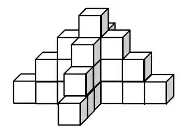
|
Students are prompted to determine how many cubes they would need to build the figure.
Initially, the image may need to be displayed rather than briefly shown. Students might need cubes to recreate the figure. Questions to Ask How many cubes? How do you know? |
Develop 3-dimensional spatial reasoning. Connect volume to multiplication. Understand that a 3D shape can be partitioned into smaller shapes, and the volume of the original shape is the sum of the volumes of the smaller shapes. Mentally “pretending” or “shifting” cubes to make shapes that are easier to quantify - foundational to many mental strategies. Use order of operations and grouping symbols to write expressions that describe the volume. Explore equivalent expressions created by different decompositions. For example, in this image, the student might think of the figure as 4 “wings” consisting of 6 cubes plus a single tower with 4 cubes. A corresponding expression is 4×6+4. Another student might decompose by layers, finding the expression (4×3+1) + (4×2+1) + (4×1+1) + 1. |
Visual Patterns Example is Pattern 52, Step 3 Toy Theater "Cube" application Virtually build 3D shapes with cubes. Shapes can be rotated, and cubes can be colored to emphasize groupings. Multiplicity Lab: Cubes |
Resources
 Collection: Instructional Routines
Related Posts:
- Number Talks
 Number Talk
 The CSA Framework: Connecting Concrete, Semi-concrete, and Abstract Representations
- SMP 7: Look For and Make Use of Structure
- EMTP 3: Use and Connect Mathematical Representations
- EMTP 4: Facilitate Meaningful Mathematical Discourse
- EMTP 6: Build Procedural Fluency from Conceptual Understanding