Number Talks
By Sumer Smith
 While the term “number talk”
can refer to various structures, components, or processes depending on the reference or resource, it is most commonly defined as a brief,
daily discourse-based routine involving classroom discussion around an intentionally crafted computation problem. In this routine, students
make sense of the problem and mentally apply strategies of their choice to solve the selected problem, then verbally share and discuss their
strategies as a class. A number talk is meant to focus on how students think about the numbers rather than simply finding the correct answer,
and over time, help students to become more flexible, efficient, and accurate in computation.
While the term “number talk”
can refer to various structures, components, or processes depending on the reference or resource, it is most commonly defined as a brief,
daily discourse-based routine involving classroom discussion around an intentionally crafted computation problem. In this routine, students
make sense of the problem and mentally apply strategies of their choice to solve the selected problem, then verbally share and discuss their
strategies as a class. A number talk is meant to focus on how students think about the numbers rather than simply finding the correct answer,
and over time, help students to become more flexible, efficient, and accurate in computation.
Number talks can create opportunities for students to make sense of mathematical relationships as they select and apply computation strategies that they find suitable for the selected problem, which moves them toward computational fluency. The teacher plays a key role in facilitating discussion, providing wait time, and recording student thinking in ways that highlight important mathematical ideas, all of which grants an avenue for students to compare their strategies and see the many flexible ways to approach a problem.
Using Hand Signals to Support Number Talks
Hand signals provide a shared nonverbal language that allows all students to participate and make their thinking visible. They give teachers a quick visual cue to gauge and manage the pacing of the routine without interrupting student think-time. Beyond just a management tool, hand signals also reinforce that the focus is on strategies and thinking, rather than speed. Using private signals makes space for students who are still processing to feel less pressure to finish quickly. These nonverbal cues help the number talk become a more inclusive space where every students' mental reasoning is valued. There are many different perspectives on the approach to using hand signals, and which to incorporate. Here are a few you might try:
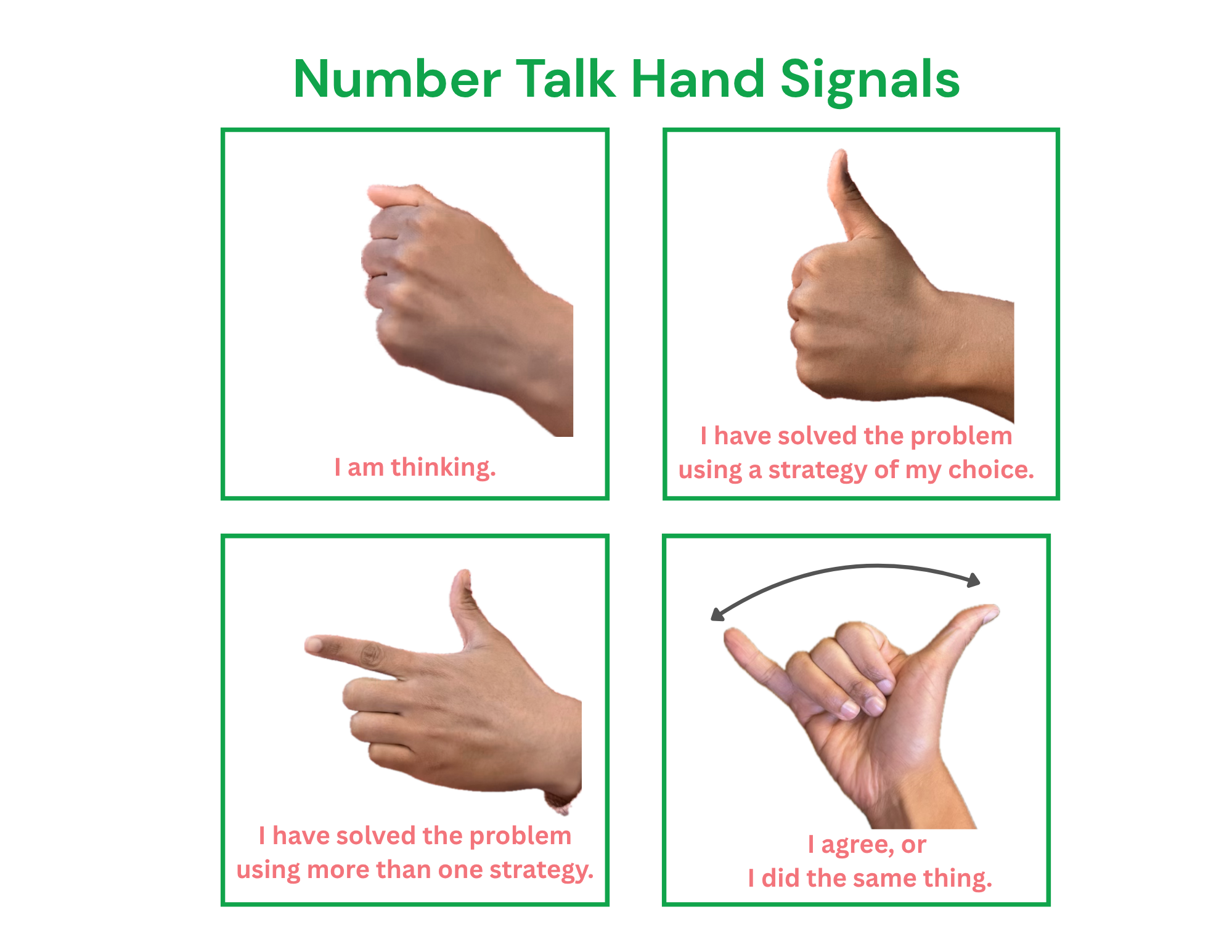
Facilitating a Number Talk
After selecting an intentionally crafted problem designed to elicit student thinking and strategies, it is time to facilitate the number talk. You may choose to gather in a consistent meeting space within the classroom where this routine regularly occurs. While there is flexibility in how the routine is responsively enacted, the following structure can support effective implementation.
Pose the problem
At the beginning of the number talk, you will pose the problem. It should be written or posted in a place that is visible to all participants and should preferably be formatted horizontally to discourage the use of rote procedures - we want students to use reasoning strategies, flexibly!
Wait time
Once the problem has been posed, provide intentional wait time so that all students feel they have adequate time to engage with the task and find a solution. Hand signals can support this phase by offering a quiet, low-pressure way for students to indicate their thinking without disrupting others. If many students signal quickly, it may suggest the problem was less complex than intended; conversely, longer wait times can indicate a more appropriately challenging task.
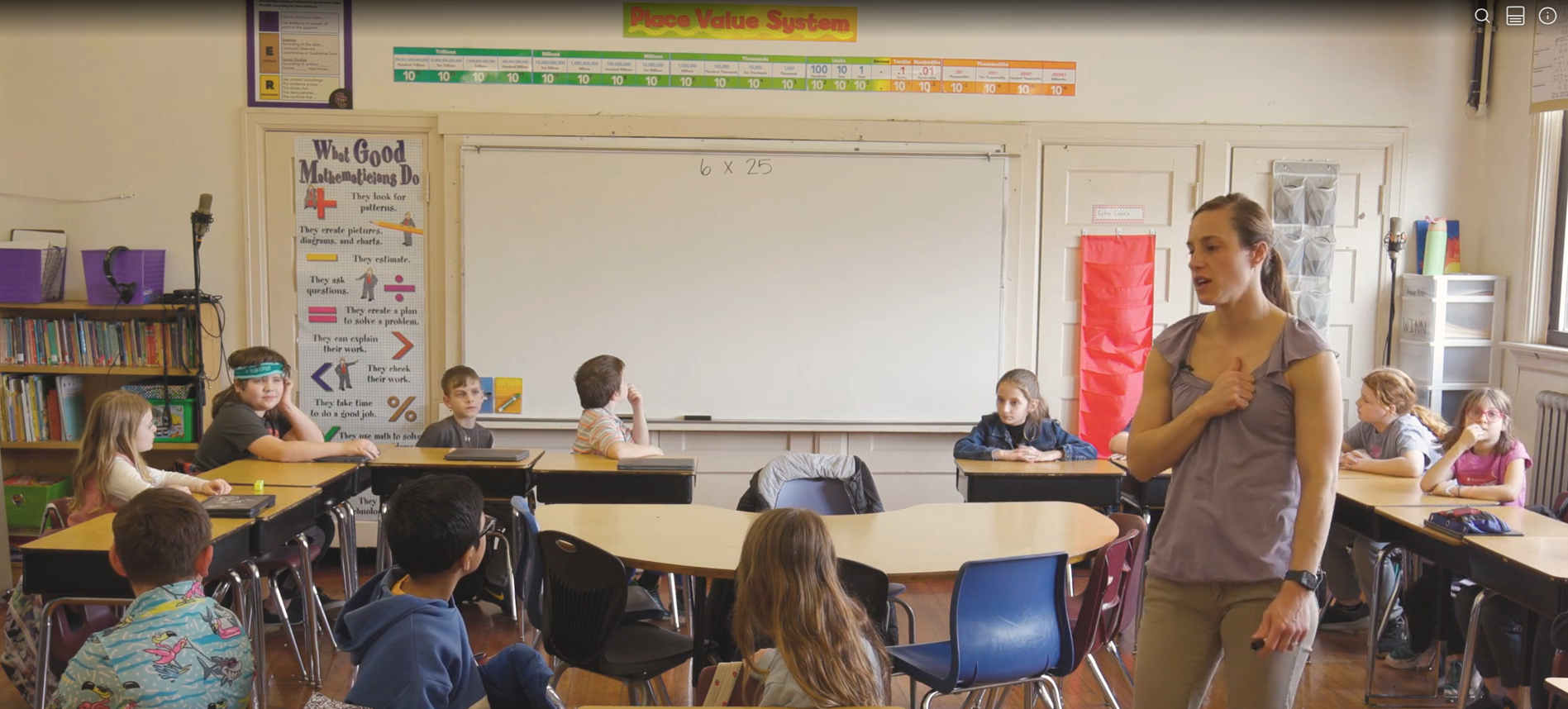
Mrs. Fields uses wait time as her fourth-grade students use hand signals
to silently note when they've solved the problem.
Collect answers
When most students have indicated they have a solution it is time to begin collecting answers. Invite students to share the answers they found and record them near the posed problem.This is not a time for students to defend answers, nor for the teacher to indicate if the answers are correct or incorrect, but rather to give a starting point for the discourse. Recording multiple answers can help generate rich and productive mathematical discourse.
Collect and annotate strategies
After answers have been recorded, invite students to share their strategies and explain their thinking. You might ask:
- Does anyone have a strategy they would like to share?
- Did anyone solve this problem in a similar way to ___? In a different way?
This phase of the routine may also include structured discourse moves such as Turn-and-Talk or Think-Pair-Share to give students time to share, and maybe revise, their thinking with a partner before sharing with the whole group. During this time, it might be beneficial to provide Number Talk Sentence Starters to help support students in communicating about their thinking to their peers.
When selecting the problem for the number talk, you likely anticipated particular strategies that would emerge. It's equally important to consider how you will record and annotate student thinking in advance. During this phase of collecting and probing strategies, it is essential to represent students' strategies clearly and with mathematical precision. Thoughtful recording makes student thinking visible and helps to support students in making connections across the various strategies.
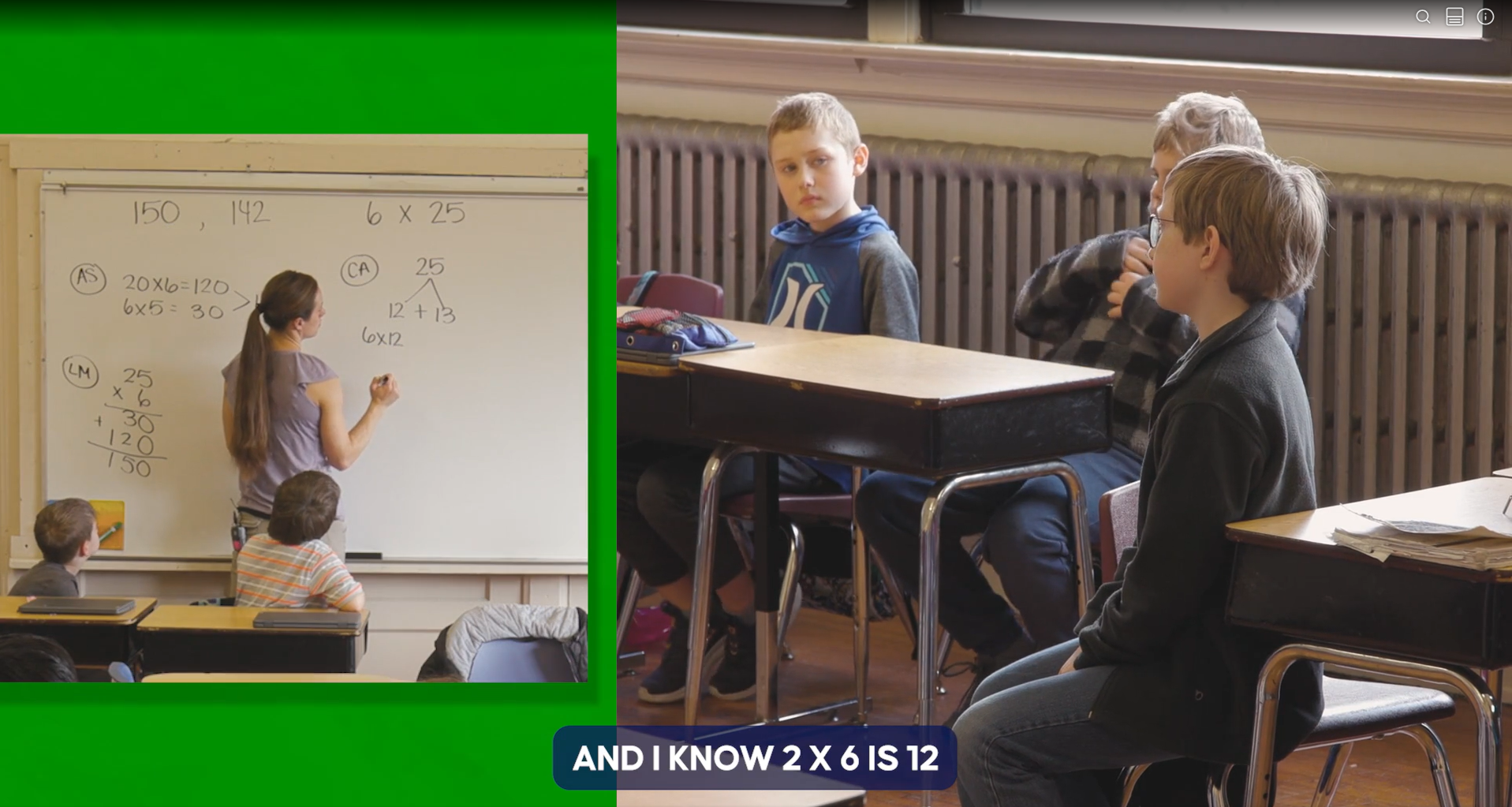
Mrs. Fields records and annotates a student's method as he verbally explains his thinking.
Pose questions and make connections
During and after the collection and annotation of strategies, you may pose questions to clarify and extend students' thinking. You may ask questions such as:
- How are these strategies the same or different?
- Why does that strategy work?
- What relationships do you notice between the numbers?
- Did you revise your original answer or strategy?
- Did you start with one method and decide a different one made more sense? Why?
- Did hearing a classmate's approach help clarify your own thinking?
- Which strategies might you try next time?
Number talks are meant to center student thinking and discourse, so devoting time to making connections and thinking deeply about the variety of approaches can strengthen their understanding and help them to internalize a strategy into their own mathematical toolbox.
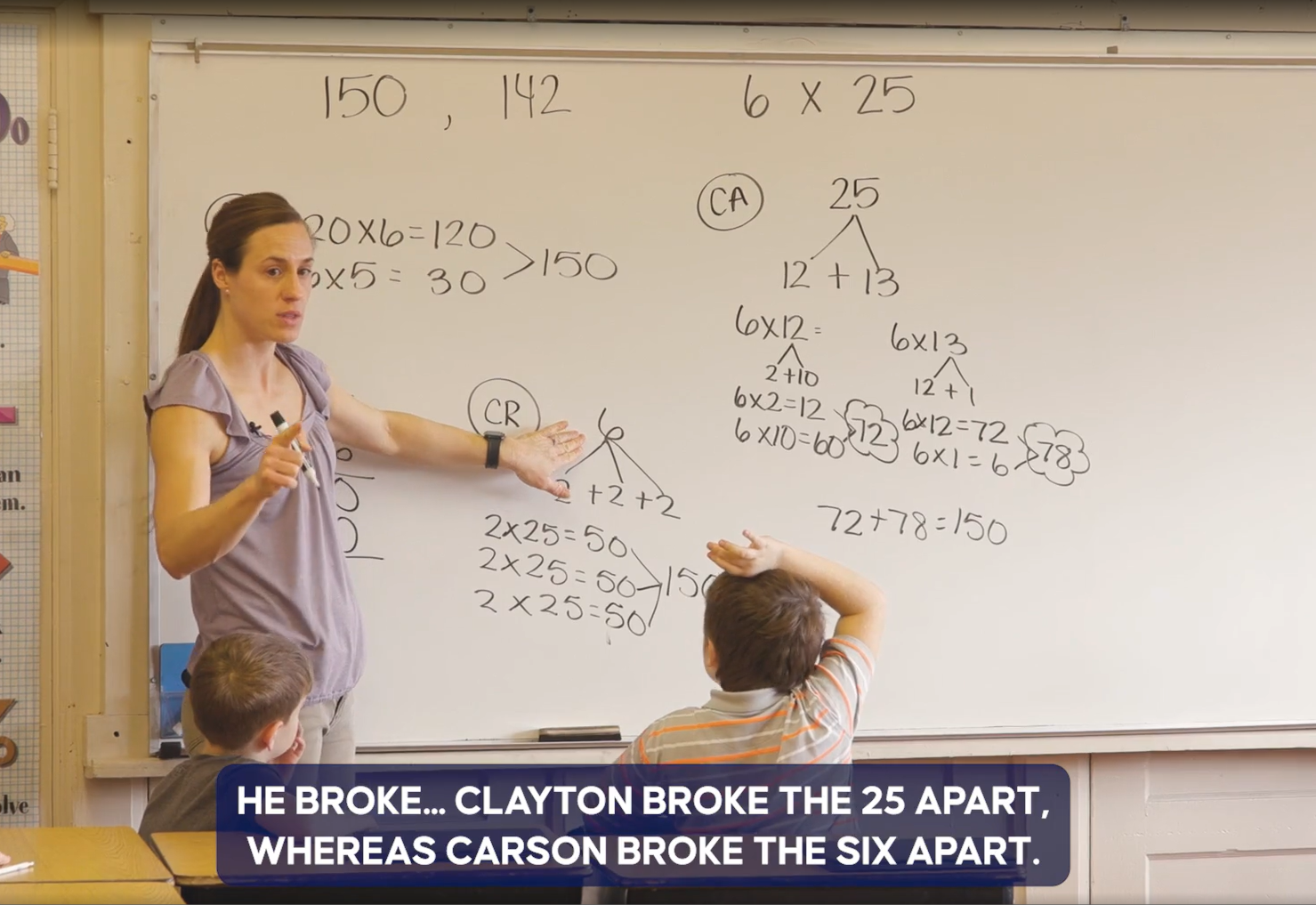
Mrs. Fields hilgights the similarities and differences between the students' approaches
in attending to the structure of the numbers.
Number talks are a powerful routine for centering student thinking, reasoning, and discourse while developing computational fluency. Through intentional problem selection and responsive facilitation, consistent number talks can support students in becoming more flexible, efficient, and confident problem solvers who learn from one another's thinking.
Resources
- Number Talks - YouCubed
- Number Talks: Whole Number Computation by Sherry D. Parrish
- Number Talks in the Primary Classroom by Kathy Richardson and Sue Dolphin
- Making Number Talks Matter Developing Mathematical Practices and Deepening Understanding, Grades 3-10 by Kathy Richardson and Ruth Parker
- Number Talks | Inside Mathematics
- Example Number Talk Facilitated by Cathy Humphreys
 Collection: Instructional Routines
Related Posts:
- Talk About Dots? Absolutely!
 Number Talk
- Problem Strings: Using Strategies to Add within 100
- Problem Strings: Using Strategies to Multiply within 100
 Procedural Fluency
- Strategy Instruction: Addition
- Strategy Instruction: Multiplication
- EMTP 6: Build Procedural Fluency from Conceptual Understanding
- EMTP 4: Facilitate Meaningful Mathematical Discourse