Beyond the Ruler: Using Number Lines to Build Number Sense
By Julie Adams (KCM)
 As a mathematics education consultant with the Kentucky Center for Mathematics, I have the privilege
of working alongside teachers who are constantly seeking meaningful ways to help students make sense
of numbers. One of the most powerful, yet sometimes underused, tools in our mathematical toolkit is
the number line. When used intentionally, the number line becomes far more than a visual aid—it
becomes a bridge connecting concrete experiences to abstract reasoning and mathematical
understanding.
As a mathematics education consultant with the Kentucky Center for Mathematics, I have the privilege
of working alongside teachers who are constantly seeking meaningful ways to help students make sense
of numbers. One of the most powerful, yet sometimes underused, tools in our mathematical toolkit is
the number line. When used intentionally, the number line becomes far more than a visual aid—it
becomes a bridge connecting concrete experiences to abstract reasoning and mathematical
understanding.
From Counting to Reasoning
In the earliest grades, students often see numbers as separate, isolated entities—“3 is three things,” “5 is five things.” The number line begins to shift that thinking. It helps students see numbers as related and connected rather than as standalone items.
On a number line, 5 isn’t just “five.” It’s two more than 3, one less than 6, and halfway between 0 and 10. These relationships help students move beyond counting to reasoning, which is foundational for number sense and flexibility.
Beyond Jumps and Hops
Many classrooms use number lines for “hopping” addition and subtraction problems—an excellent starting point, but only one small piece of what’s possible.
The true power of the number line shows up when students use it to:
- Compare magnitudes
- Visualize rounding and estimation
- Locate fractions and decimals
- Reason about intervals and distance
- Explore negative numbers
Bridging Representations
The number line is a bridge between discrete and continuous thinking. It connects concrete models such as ten-frames, base-ten blocks, and part-part-whole diagrams to more abstract reasoning.
For example, when students use an open number line to represent 27 + 36, they can decompose the numbers and jump flexibly—perhaps adding 30, then 6, or 50, then 13. Each choice reflects their thinking and reinforces mental computation and place value understanding.
Over time, this flexibility builds not just fluency, but confidence.
Inviting Students Into the Conversation
One of the most effective ways to deepen students’ understanding of number lines is to have students create their own.
When students determine where to place numbers, how to partition intervals, or how to label the line, they make their thinking visible. This opens space for rich discussion and formative assessment.
Ask questions such as:
- If you start at 5 and move back 3, where do you land? What does this tell you about subtraction?
- Which number is closer to 10 on the numberline - 7 or 12? How do you know?
- Where would 37 go on the number line? What do you notice about its location?
- “Where would you place ¼ on a number line between 0 and 1? How do you know?”
- “What would happen if we zoomed in between 4 and 5?”
- “How could we show 2.3 on this same line?”
A Representation That Grows With Students
The number line is one of the few representations that grows with students throughout their mathematical journey.
.png)
A number path, such as the ones shown above, can help a kindergartener count and compare.
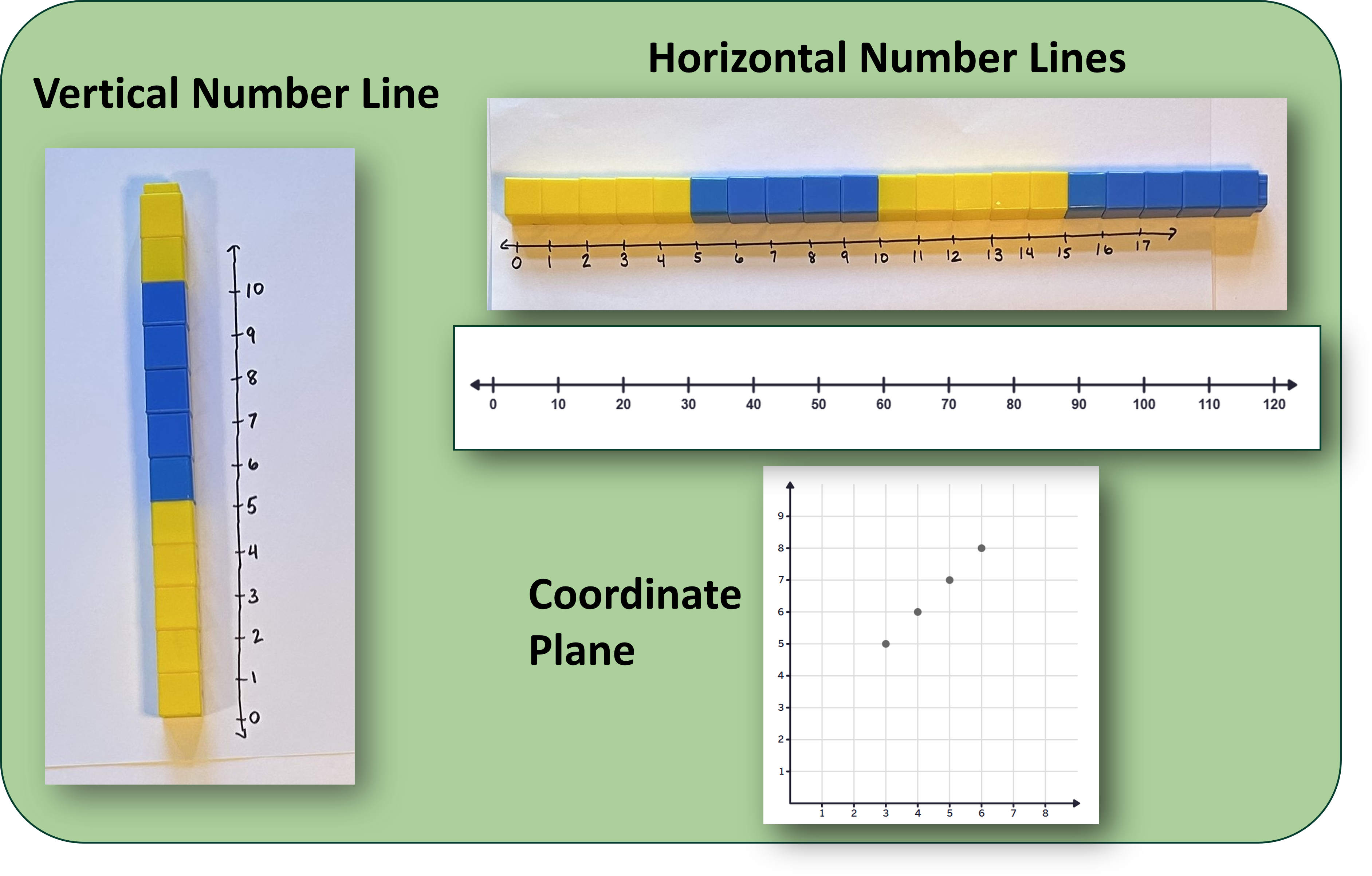
Gradually, students extend their early understandings of number paths and linear measurement to horizontal and vertical number lines. A third grader can reason about place value and rounding by considering a number’s position on a number line and how close it is to a benchmark number. A fifth grader might compare fractions and decimals by thinking about their relative locations on a number line. Middle school students locate integers on a number line, understanding that -4 and 4 are located the same distance from 0 but in opposite directions. Students build on their understanding of number lines to graph points and eventually functions on a coordinate plane, recognizing that the axis of a coordinate plane is composed of a pair of perpendicular number lines.
The number line is a visual that stays consistent while the mathematics around it becomes more complex.
Closing Reflection
Representations matter. They shape how students make sense of mathematical ideas and how deeply they understand them. The number line—simple, flexible, and profoundly visual—deserves a central place in our classrooms.
When used intentionally, it doesn’t just help students solve problems - it helps them see mathematics.
Try This
In your next math lesson, invite students to construct their own number line for a familiar context—such as counting collections, showing distances, or comparing fractions. Listen closely to their reasoning as they explain their choices. Their placement, spacing, and labeling decisions can open a window into how they understand number relationships.
How are your students using the number line to make sense of math? I’d love to hear your reflections or examples—share your ideas with the KCM on social media and tag KCM in your post!

