More Than Keywords: Strengthening Word Problem Instruction
By Julie Adams (KCM)
 If you’ve ever worked with students who struggle in mathematics, you’ve likely seen this
pattern: A student can compute accurately during practice, but when faced with a word
problem, everything seems to fall apart.
If you’ve ever worked with students who struggle in mathematics, you’ve likely seen this
pattern: A student can compute accurately during practice, but when faced with a word
problem, everything seems to fall apart.
For many students, word problems are where mathematical understanding is stretched — and sometimes exposed. As educators, this puts us in a powerful position. Our work isn’t just about helping students get answers; it’s about helping them make sense of the mathematics within a situation.
Why Word Problem Instruction Matters
Word problems ask students to do more than calculate. They ask students to interpret, reason, and apply their understanding of numbers and operations. For students who struggle, this can feel overwhelming — especially if their previous experiences have focused on speed, keywords, or guessing the operation.
Effective word-problem instruction is explicit, intentional, and structured. This doesn’t mean telling students what to do; it means teaching them how to think. Word problems become an opportunity to slow things down. They allow us to focus on meaning:
- What is happening in the situation?
- What quantities are involved?
- What is the problem really asking?
When students begin to see word problems as something they can understand, not just decode, their confidence grows alongside their competence.
Moving Beyond Keywords
Many students have been taught to look for keywords such as altogether, left, more, or each to decide what operation to use. While this strategy may seem helpful on the surface, it often breaks down quickly. The same word can appear in different types of problems, and different words can describe the same underlying structure.
A more productive approach is to shift the focus from keywords to sense-making. Instead of asking, “What word tells me what to do?” we can help students ask:
- “What is happening in this situation?”
- “What do I know, and what do I need to find out?”
- “How are these quantities related?”
This shift aligns directly with the intent of the KAS and supports a deeper understanding that helps students apply their thinking more flexibly.
Using Problem Types to Build Understanding
The Kentucky Academic Standards offer a helpful lens for this work by organizing word problems around problem types, rather than operations alone. These problem types highlight the structure of a situation, which is something students can learn to recognize over time.
Addition and Subtraction Problem Types (KAS: Table 1)
Students benefit from experiences with:
- Join and Separate situations (with different unknowns)
- Part-Part-Whole relationships
- Compare problems that focus on difference rather than direction
It’s especially powerful to revisit problems where the unknown is not the result. These problems push students to reason about the situation rather than relying on keywords.
Multiplication and Division Problem Types (KAS: Table 2)
As students progress, problem types such as:
- Equal groups
- Arrays and area
- Comparison
For each of these problem types, the unknown could be the product or the unknown could be a factor, or, equivalently, the result of a division expression. Division problems have two main interpretations: measurement, in which a quantity is divided by determining how many equal groups of a given size can be made, or sharing a quantity, which is split evenly into a given number of groups. These situations help students understand division as both “how many in each group?” and “how many groups can be made?”, building a deeper understanding of division concepts.
Help students understand when and why multiplication or division makes sense, as well as the connection between multiplication and division. Focusing on structure helps students see connections between these operations rather than treating them as separate skills.
Representations Make Thinking Visible
Word-problem instruction is most effective when students have tools to show their thinking. Drawings, number lines, bar models, and equations all help bridge the gap between the story and the mathematics.
As you look at the student work samples below, consider what this might reveal about the student’s understanding of the problem situation and the relationships within it.
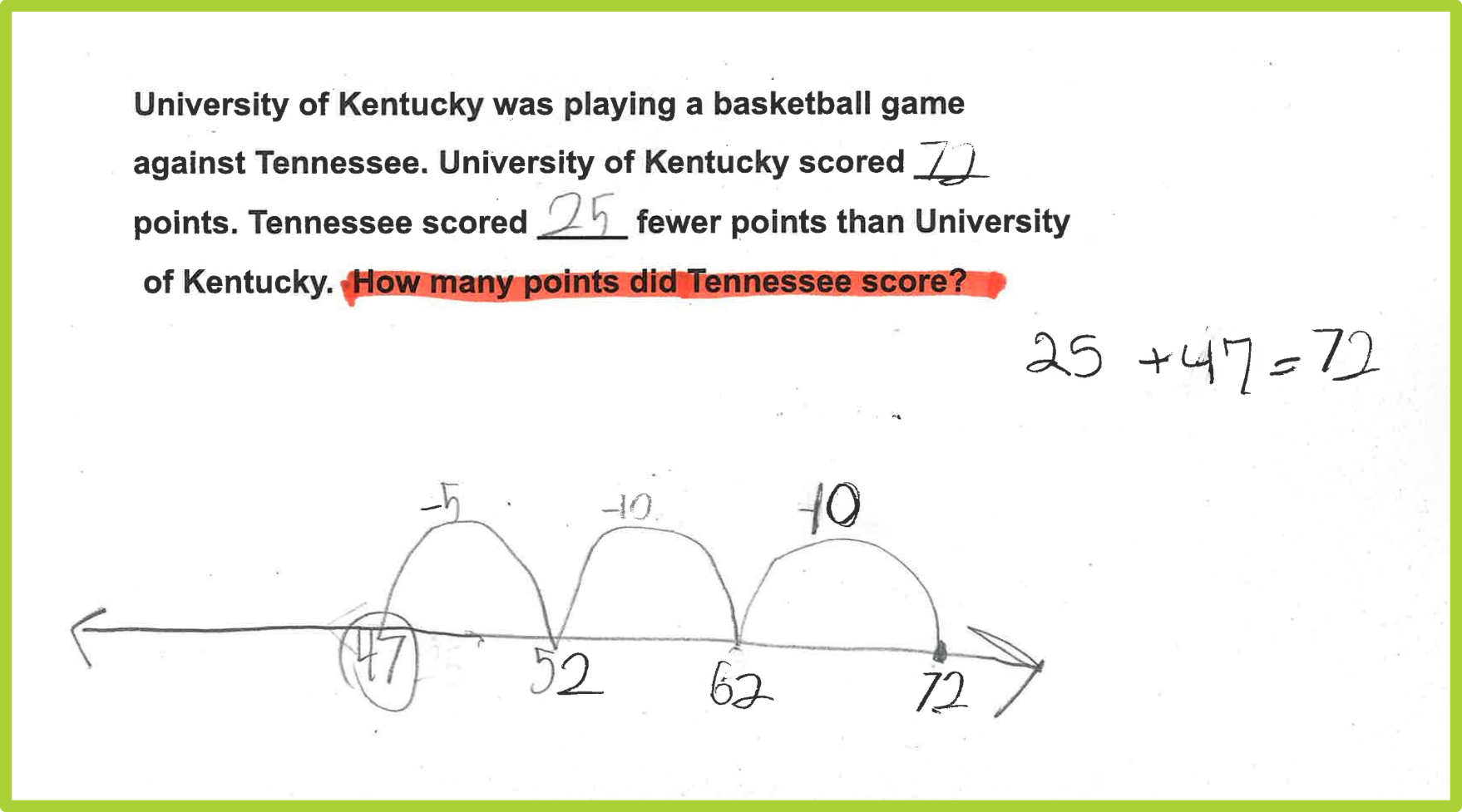
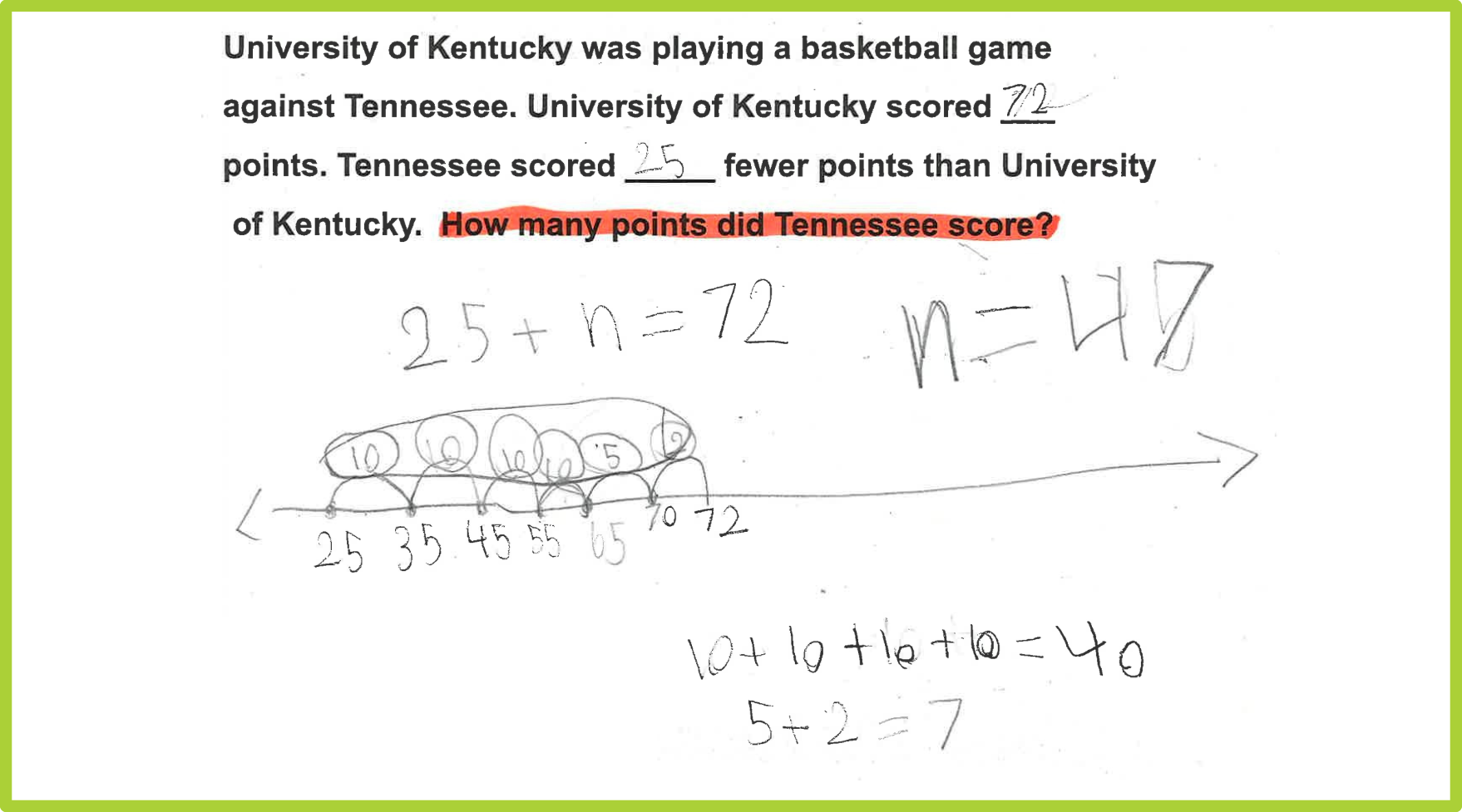
Initially, students’ representations might not be neat or formal — but they will help to make relationships visible. When students can point to their work and explain what’s happening, we gain insight into their understanding and can respond more intentionally.
A Final Thought for Educators
Supporting students with word problems isn’t about finding the fastest strategy or the right keyword. It’s about helping students make sense of mathematics in meaningful ways.
When we focus on problem structure, encourage reasoning, and align our instruction to the Kentucky Academic Standards problem types, we give students something more durable than a trick. We allow them to justify their thinking, give them space to apply mathematical ideas with confidence, and essentially, we give them the gift of understanding.
And for students who have struggled for a long time, that understanding can be a turning point.
As educators, our work sits at the intersection of patience, precision, and possibility. By teaching word problems deliberately without reliance on keywords and with a focus on meaning, we help students develop the understanding they need to access grade-level mathematics and see themselves as capable problem solvers.
Resources
- IES Practice Guide Assisting Students Struggling with Mathematics: Intervention in the Elementary Grades (2021), Recommendation 5
- Numberless Word Problems - Created by Brian Bushart, this site outlines the steps for implementing the numberless word problem routine and includes banks of prepared slide decks to get you started.
- Problems to Pose to your Students at the Beginning of the School Year - CGI Math Teacher Learning Center
- Children’s Mathematics: Cognitively Guided Instruction (Carpenter et al.) explores how children solve problems using their intuitive understanding of addition, subtraction, multiplication, and division.

