Seeing Beneath the Surface: Why Fluency Readiness Assessments Matter
By Funda Gonulates and Cindy Aossey

When we talk about fluency in mathematics, we often think about speed and accuracy. But true fluency is much more than quick answers. It reflects students’ understanding of mathematical relationships, their ability to use multiple strategies flexibly, and their capacity to make sense of numbers and operations (NCTM, 2017). Fluency develops over time, supported by strong conceptual foundations and intentional instruction.
Most traditional assessments focus on whether students can demonstrate fluency—the visible outcomes of learning. What teachers often need, however, is a way to understand what lies beneath the surface: the conceptual understandings and foundational skills that prepare students to become fluent. This is where KCM Fluency Readiness Assessments play an essential role.
Fluency readiness can be thought of as the unseen part of an iceberg. While fluency is what we can easily observe, readiness represents the reasoning, number sense, and conceptual understanding that support students’ long-term success. The iceberg graphic here illustrates the critical foundations necessary for developing fluency with addition and subtraction within 20. Fluency Readiness Assessments, created by the KCM, help teachers document and monitor students’ development over time, providing meaningful formative data that informs instruction, intervention, and pacing decisions.
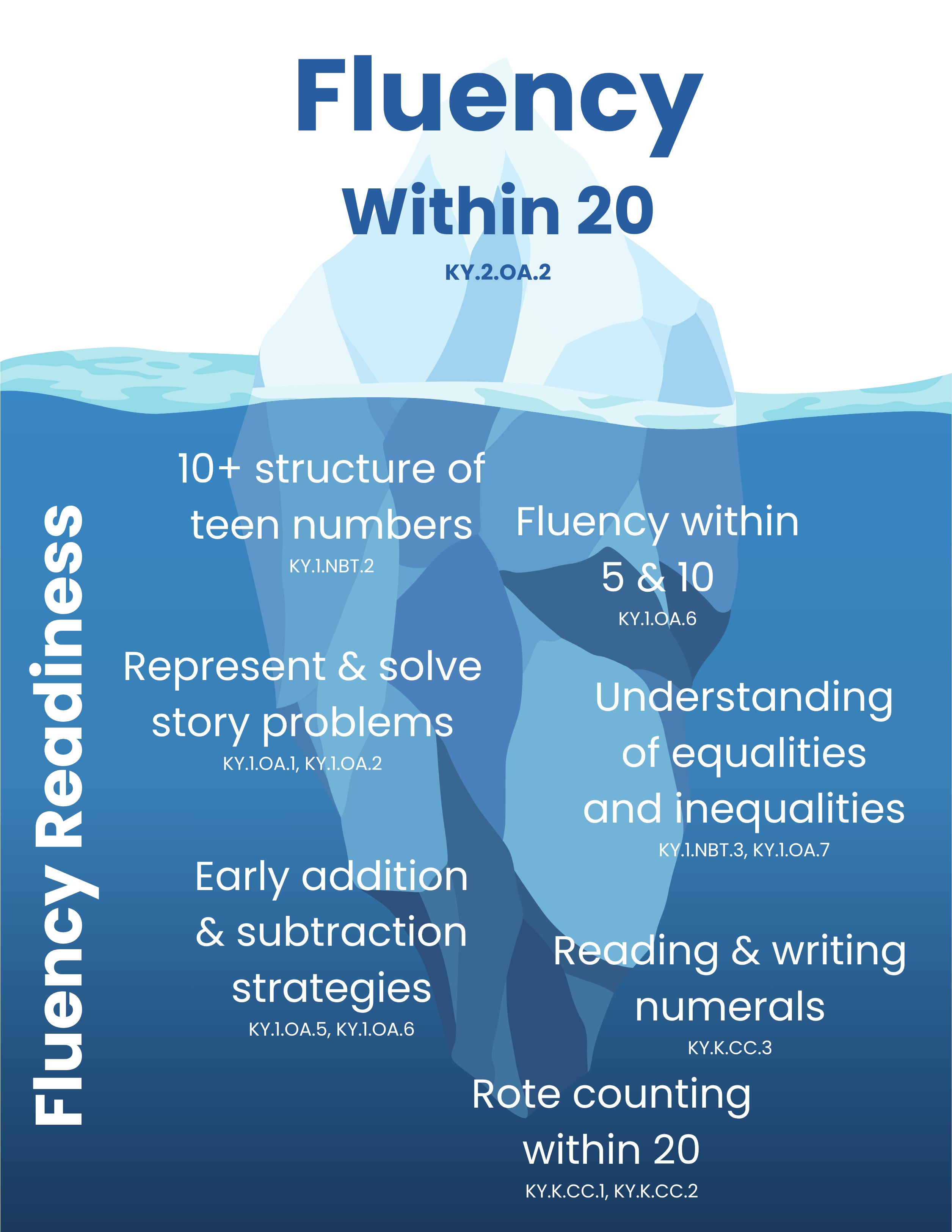
These assessments are designed to reveal how students reason about numbers, move across representations (visual, symbolic, and contextual), connect equivalent expressions, and apply multiple strategies in ways that make mathematical sense. Rather than focusing only on a perfected outcome, fluency readiness emphasizes the learning process and allows us to see how students think, explain, and justify their strategies as they prepare for more abstract thinking. This allows teachers to respond instructionally, targeting supports and designing learning experiences that build toward durable, conceptually grounded procedural fluency.
Available Fluency Readiness Assessments
Current fluency readiness assessments primarily focus on number sense, place value understanding, and addition and subtraction as operations, supporting the development of computational fluency across the elementary grades. The following assessments are currently available:
| Fluency Readiness Assessments for Addition & Subtraction | ||
|---|---|---|
| Assessment |
Intended to support Tier 1 instruction for: |
Description |
| FRA 10 | Beginning of Grade 1 | Captures foundational counting concepts, number recognition, quantity relationships, and early composing and decomposing of numbers. These skills support students’ readiness for addition and subtraction within 10. |
| FRA 20 | Beginning of Grade 2 | Focuses on extending number relationships, operation sense (addition and subtraction), initial symbolic reasoning, and early place value concepts that support fluency within 20. |
| FRA 100 | Middle of Grade 2 | Emphasizes place-value understanding, composing and decomposing tens and ones, and addition and subtraction within 100. |
| FRA 1000 | Beginning of Grade 3 | Assesses deeper place-value understanding, multi-digit reasoning, and strategies that support efficient and flexible computation within 1000. |
| Together, these assessments provide a developmental progression of number sense and place-value understanding aligned with addition and subtraction operations. | ||
Additional Assessments
Multiplication Fluency Readiness Assessments are currently in development and will expand the progression to include foundational multiplicative reasoning. Two Fraction Readiness Assessments are available, and more are being developed that assess the critical foundations for understanding fractions as numbers and operating with fractions.
Administering the Assessments
Each Fluency Readiness Assessment is structured as a short interview that assesses both foundational skills and conceptual understandings. A script, scoring rubric, and printable prompts & visuals are provided for each assessment. Consider the 1-minute video below of selected tasks from the Fluency Readiness within 20, Test 1.
The FRA 20 consists of 14 tasks, all of which are administered by the teacher, using the script and
rubric available here:  KCM FRA 20 Test 1 Script and
Rubric.pdf This full interview lasted 8 minutes and
46 seconds. The video clip highlights examples of both basic skills and conceptual understanding
questions.
KCM FRA 20 Test 1 Script and
Rubric.pdf This full interview lasted 8 minutes and
46 seconds. The video clip highlights examples of both basic skills and conceptual understanding
questions.
In the video, the student responds to questions targeting basic skills (Tasks 2, 3, and 4) and conceptual understanding (Task 8). One moment that really stands out in the video happens during Task 8, when the teacher adds a follow-up question that wasn’t part of the original script. She asks the student why they chose to solve 7–6 when the original problem was 17–6. This small move invites us to slow down and really listen to the student’s thinking. What does this choice tell us about how the student is making sense of the numbers? What early ideas about place value might be emerging? This follow-up prompt provided insight into the student’s reasoning and early place-value understanding, which are critical for developing a strong foundation for fluency with 20.
These assessment resources include a task-specific rubric that supports precise scoring. For example, on Task 2, a student may correctly count backward, but how he performs this skill provides critical information for accurately diagnosing his level of readiness. The rubric descriptors for this question are
- 0 - Makes an error when saying the number sequence
- 1 - Correctly says the number sequence, but there are concerns such as needing to count from 20, having more than one self-correct, or long pauses
- 2 - Correctly says the number sequence at a steady pace with at most one self-correct or clarifying prompt
Using clear and observable language like in this example would allow teachers to more authentically capture student thinking and strategies.
These assessments are designed not only to describe students’ current level of readiness, but can also be used for ongoing progress monitoring. For this reason, we created nine versions of each test. Each version is conceptually parallel and aligned to the same instructional goals, with careful attention to keeping the numbers and task demands comparable.
Why Fluency Readiness Matters
By focusing on readiness rather than only final outcomes, teachers gain insight into what students understand, what strategies they rely on, and where misconceptions may exist. This supports responsive instruction, equitable access to learning, and intentional scaffolding toward fluency. Fluency Readiness Assessments empower educators to make instructional decisions that honor students’ thinking and promote long-term mathematical success.
Fluency is what we see. Fluency readiness is what makes fluency possible.
