Fact of the Day Transformed by Student Agency
By Bethany Neel
 In my third grade classroom,
I had been doing what felt like a pretty standard and effective daily fluency routine with my students: Fact of the Day.
However, when my students used the agency they had developed in our classroom to make the routine their own, it became
more engaging, richer, and deeper.
In my third grade classroom,
I had been doing what felt like a pretty standard and effective daily fluency routine with my students: Fact of the Day.
However, when my students used the agency they had developed in our classroom to make the routine their own, it became
more engaging, richer, and deeper.
It started with a simple daily routine. As we were learning multiplication, I presented students with a fact of the day. I started with foundational facts, and then carefully chose a sequence of daily facts designed to highlight strategies and relationships and build new strategies. We would keep a list of the recent facts and share and discuss how one fact might connect to another. Essentially, we were doing a problem string (to learn more, see our Reel Classroom video problem strings) over multiple days.
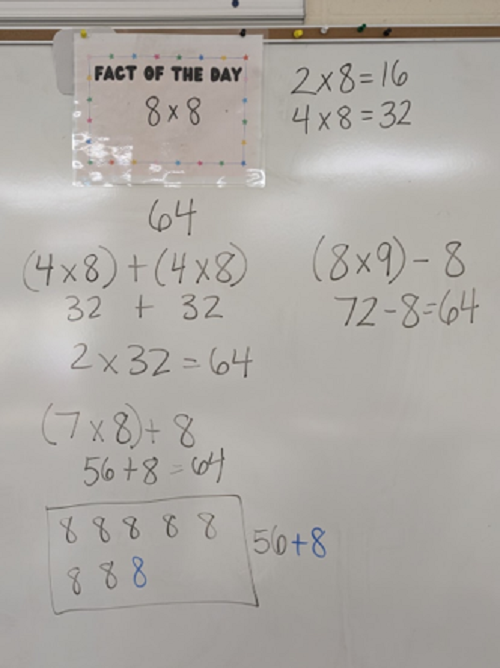
When we were transitioning to the carpet, students were asked to think about the Fact of the Day and share and compare their strategies with a partner. Most days, we would record some student thinking on the board. This photo was taken well into our multiplication unit when students were using doubling to do more than multiply by twos. You can see that students made connections to the previous facts of the day listed on the right, but they also used other appropriate and efficient strategies.
Students were seeing connections and relationships between the facts of the day, explaining them well, and it smoothed what could be a bumpy transition time in my classroom. I thought I had something great going. Little did I know how much more it would become.
We finished our multiplication unit, and as we began learning about fractions, I continued to present students with a multiplication or division fact of the day to continue their progress toward the important third grade fluency standard.
After our first fraction quick check, we reflected on our data and what students had learned about fractions so far. Students came together and shared what went well and what could change to improve their learning. One of my students had a suggestion that the fact of the day was not helping them learn about fractions and should become a fraction of the day. That student wasn't quite sure what that might look like, so I wrote it down and asked everyone to start thinking about it. After several informal conversations between students, some of them including me, they had a plan. We would consider a fraction each day and then name other fractions that would be a larger, smaller, or equivalent part of the whole. I was amazed by their idea. So Fact of the Day turned into a Fraction of the Day.
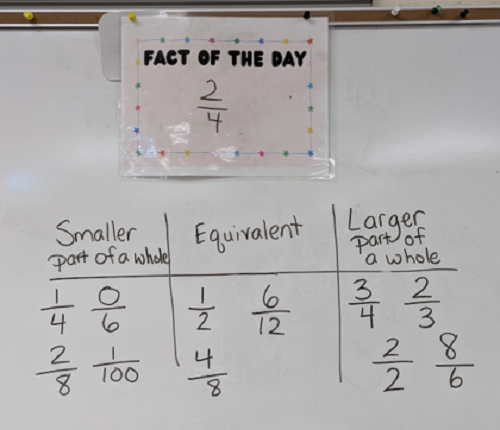
I started choosing fractions of the day, being very purposeful in my selections to build fluency over time. Students were using strategies such as thinking of fractions with the same denominator, same numerator, or using the patterns they learned exploring equivalent fractions to come up with a wide variety of responses, including many that went well beyond the third grade standards. I was amazed and impressed with their thinking. But they weren't done yet.
My students exercised their agency yet again. I start the year with some standard classroom jobs that students apply to do, and they are encouraged to propose additional classroom jobs. They suggested that a student could come up with the fraction of the day and put it on our poster each day. I was somewhat reluctant to give this over to a student - how would they know what fractions would be good to choose? How would they be sure to stick to the third grade standards? Would the fractions they chose allow an entry point for all my students? We had been working with fractions for a while, so I decided to give it a try, and I am so glad that I did. At first she stuck with simple, third grade fractions and we all enjoyed Fact of the Day even more, eager each morning to see what she chose.
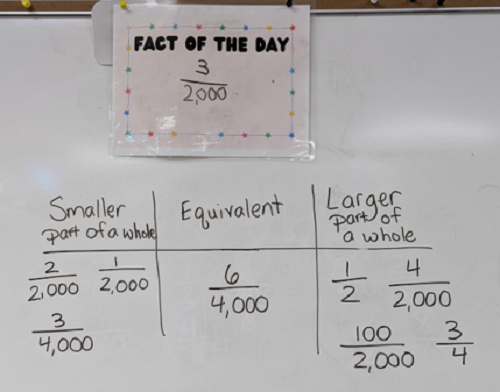
More and more fractions beyond the range of the third grade standards started to make their way naturally into our learning. For example, to emphasize the idea that the more pieces in a whole, the smaller the pieces become, we talked about things like sharing a cake with every classroom teacher in the school so each person would receive (1/27.) Fractions like 1/27, 1/100, and 3/1,000 started to appear in students' responses to the Fact of the Day as they reasoned about the size of the pieces. Then, one day, I saw the Fraction of the Day: 3/2,000. My first thought was to ask the student to change the fraction - I thought it might frustrate many of my students, and although we had explored and found patterns with equivalent fractions, we were using models and had never tried finding something equivalent to a fraction like that! Thankfully I chose to trust that the reasoning students' had built would support them. They did not disappoint.
Students started talking, and very quickly used fractions with the same numerator or denominator to generate fractions that were a larger or smaller part of the whole. Then the discussion of equivalent fractions began. Some students were stumped and had a wonderful conversation about how they could build the fraction and find something equivalent, but they recognized that would be an unrealistic thing to do. Finally, a student called me over and said they thought they had it - would 6/4,000 be equivalent? They explained that if you cut each piece in half, you would end up with 4,000 pieces and those 3 pieces would become 6 pieces. I was blown away. It turns out that the reasoning and understanding we had built through modeling and comparing fractions with small denominators was strong enough to support thinking like this. Then it became REALLY fun and engaging.
We finished our fractions unit and I decided that we needed to go back to multiplication and division fluency practice with the fact of the day. At this point we were working with word problems, many involving time, capacity, and mass. My students reminded me that we were always solving with a unit and that it made sense to include a unit in our fact, so our Facts of the Day became things like 9 x 8L and then students were solving the expression (72L in this case) and coming up with a story context that could match the expression. (One possibility: There were 9 buckets of water, each holding 8L. How many liters of water were there in all?)
As we moved into geometry, they started thinking about how the Fact of the Day could become the Polygon of the Day. It was such a joy to see them make this routine their own and talk about how it could support their learning. The students in my class this year truly possessed agency over their learning, and exercised it in such beautiful and meaningful ways. I am so grateful that what started as a simple routine led to such creativity and joy in mathematics for my students and became a favorite part of our day. I can't wait to see what they come up with next!!!! When students have choice and influence over their learning, what they do with it is bound to surprise and delight you!
Related Posts:
 Productive Mathematical Dispositions
- Mathematical Dispositions: Curiosity and Confidence
- Mathematical Dispositions: Relevance and Community
- Mathematical Dispositions: Enjoyment and Creativity
- Strategy Instruction: Multiplication
- EMTP 7: Support Productive Struggle in Learning Mathematics
- EMTP 8: Elicit and Use Evidence of Student Thinking
- Always, Sometimes, Never