Counting Collections: When Collections Get Fractional
By Funda Gonulates (NKU) and Cindy Aossey (KCM)
 When we think of Counting Collections (Franke, Kazemi & Chan, 2018) in elementary math
classrooms, we typically imagine students
counting with whole numbers, such as when they count collections of bears, buttons, cubes or
counting chips.
To learn more about Counting Collections, see the related posts listed below.
When we think of Counting Collections (Franke, Kazemi & Chan, 2018) in elementary math
classrooms, we typically imagine students
counting with whole numbers, such as when they count collections of bears, buttons, cubes or
counting chips.
To learn more about Counting Collections, see the related posts listed below.
But have you ever considered using fractional units when counting collections? Counting collections with fractions is a powerful way to deepen mathematical thinking and support students in building a more flexible understanding of quantities and fractions as numbers.
The key is to provide collections with whole units and sub-units so that students can reason about parts of a whole, not just whole numbers. Counting collections with fractions offers a rich opportunity for students to explore equivalence, part-whole relationships, and unitizing while redefining units and wholes, all of which support the development of flexible thinking about quantities.
Variations of Engagement
Students can be provided with either a mixed, or “messy,” collection consisting of different-sized units, or a single-unit collection consisting of identically sized fractional units. Fraction circles, pattern blocks or Cuisenaire Rods (C-rods) are ideal for messy collections because students can express one unit in terms of others—for example, recognizing that three rhombi make a hexagon. When creating messy collections, start by limiting a collection to 2-4 units that relate well to each other, such as a collection for fraction circle pieces that includes thirds, sixths, and twelfths.
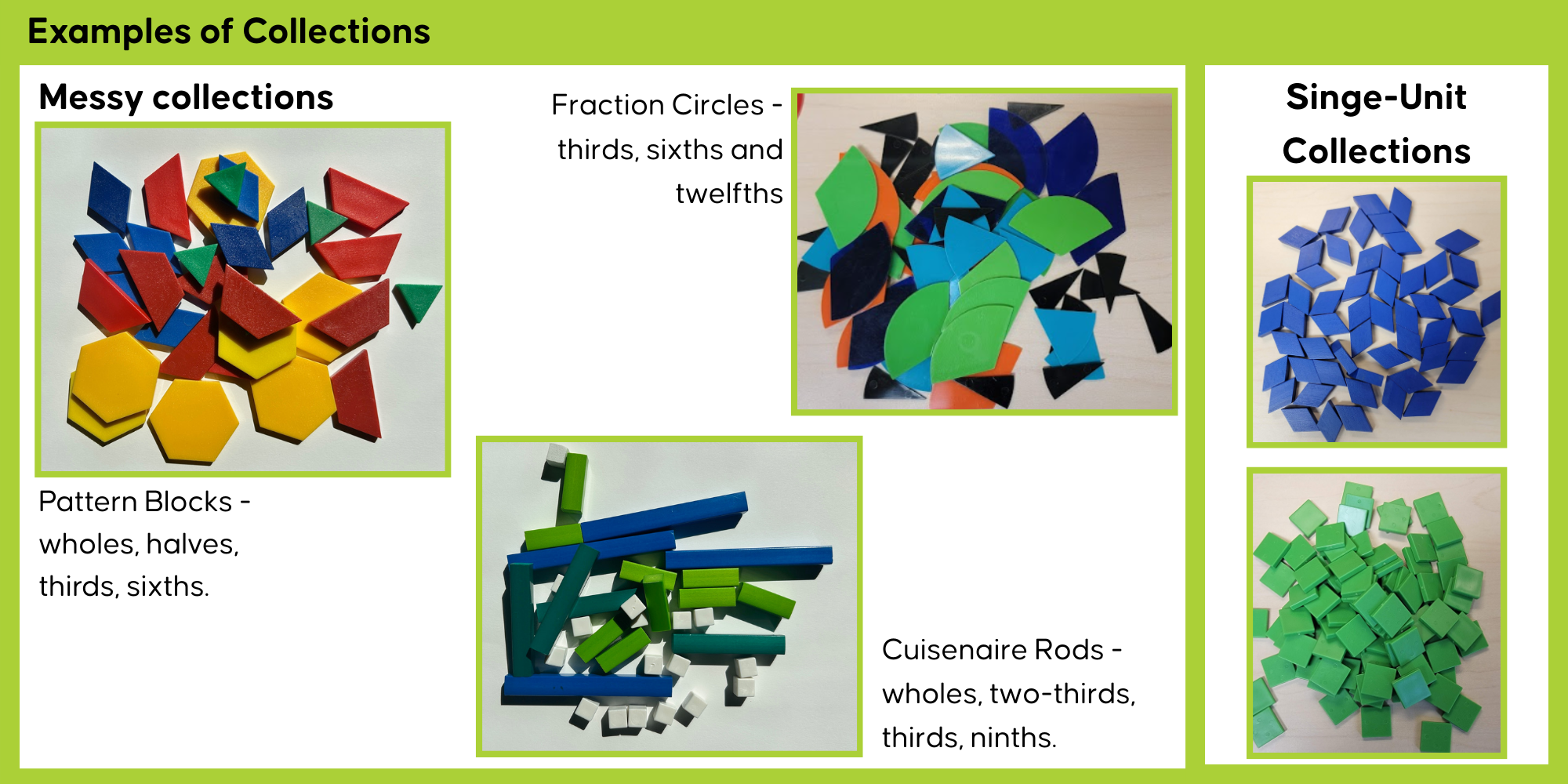
Rather than prescribing a single method of counting, students can engage in a variety of ways depending on the materials and prompts provided. Students with emerging understandings may start by simply counting the number of pieces (e.g., there are 34 pattern blocks). With deeper understandings, students may use a range of approaches including, but not limited to:
- Keeping a running total as they count each piece
- Sorting by size/type of piece then find a total for each group
- Choosing an organizing unit, such as one whole, and organizing pieces into groups of that size (e.g., put together 2-thirds and 2-sixths to make one whole)
Sometimes the teacher may define the whole for students, such as stating that the yellow hexagon in pattern blocks represents one whole, prompting students to determine the value of other pieces relative to it. In other instances, students may be invited to define the unit themselves, encouraging critical reasoning about relationships between parts and wholes.
Engaging students in these kinds of explorations encourages students to revisit their strategies, compare approaches, and consider how the total count shifts depending on the unit used.
Messy Collections
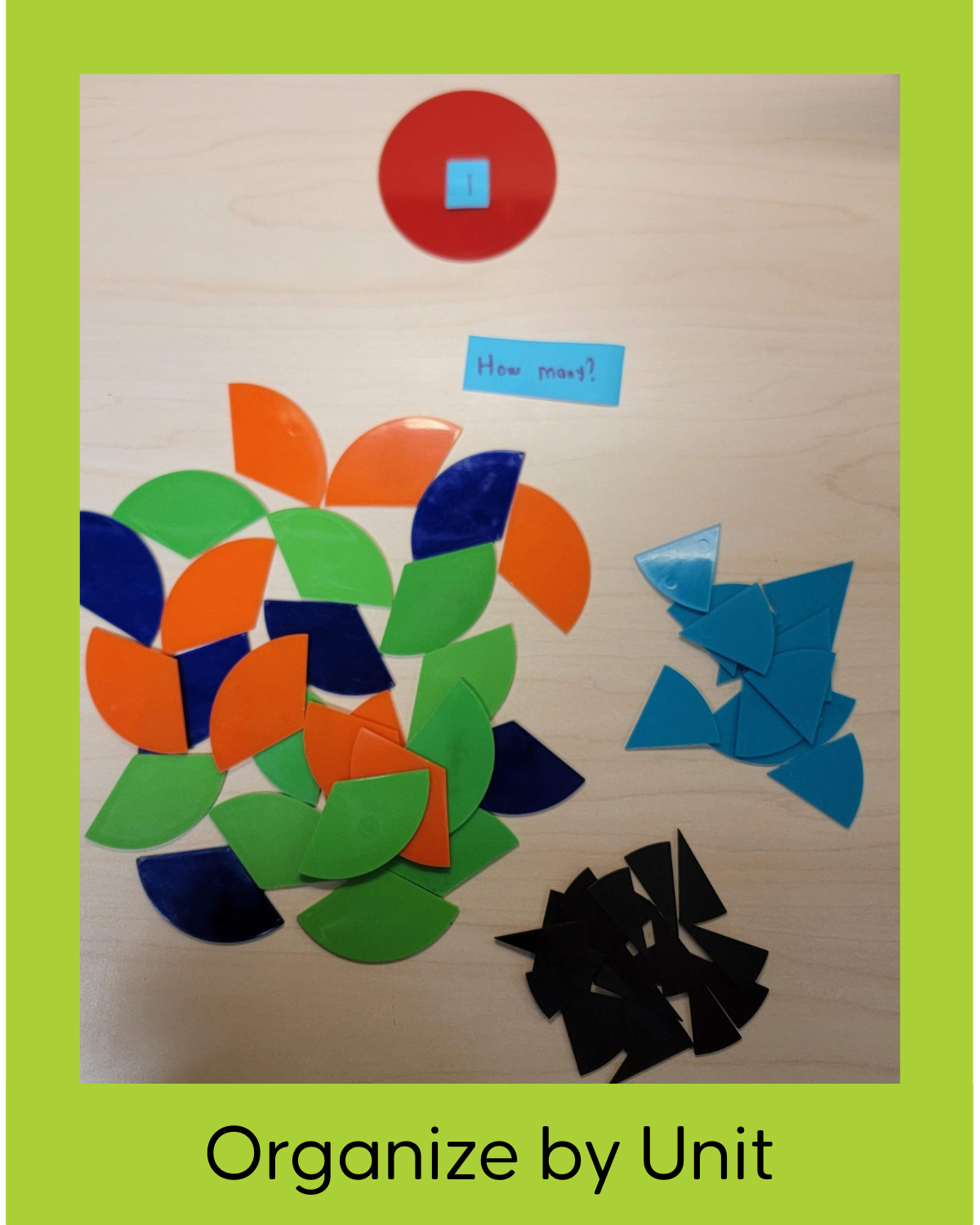
Let's consider an example of a messy collection of fraction circles that only includes thirds, sixths, and twelfths. A teacher might present the collection and simply ask, “How many?” allowing for an open exploration. With that prompt, students might sort and group pieces by type, combine pieces to form wholes, or count based on a repeated unit.
We can consider these possibilities by reviewing these possible student responses.
Organizing by Unit
Imagine a group organized this messy collection of units into piles of like units before counting. They recognize the value of each unit in different piles. They would count the items in each pile separately. Then they would determine the total number in the collection by adding the results from each pile. You may expect to see symbolic reasoning in addition to this physical exploration with fraction circles.
Student recording could include a numeric expression such as:
Students might work symbolically to determine “how many,” or their reasoning may shift between symbolic representations and physical exploration. As they interact more with the pieces, they may notice relationships such as two sixths is equivalent to a third, four twelfths is the same as a third, or two twelfths is equivalent to a sixth. These observations can help them determine the total value of the collection using a common unit.
In some cases, students may initially express their result using multiple units, and the teacher can extend their thinking by asking: “Is there a way to say how many as a single fraction or a mixed number?” “Is there a way to find how many using just one unit?” This encourages students to revisit the collection and consider more efficient or unified ways of representing the total collection.
Building Wholes
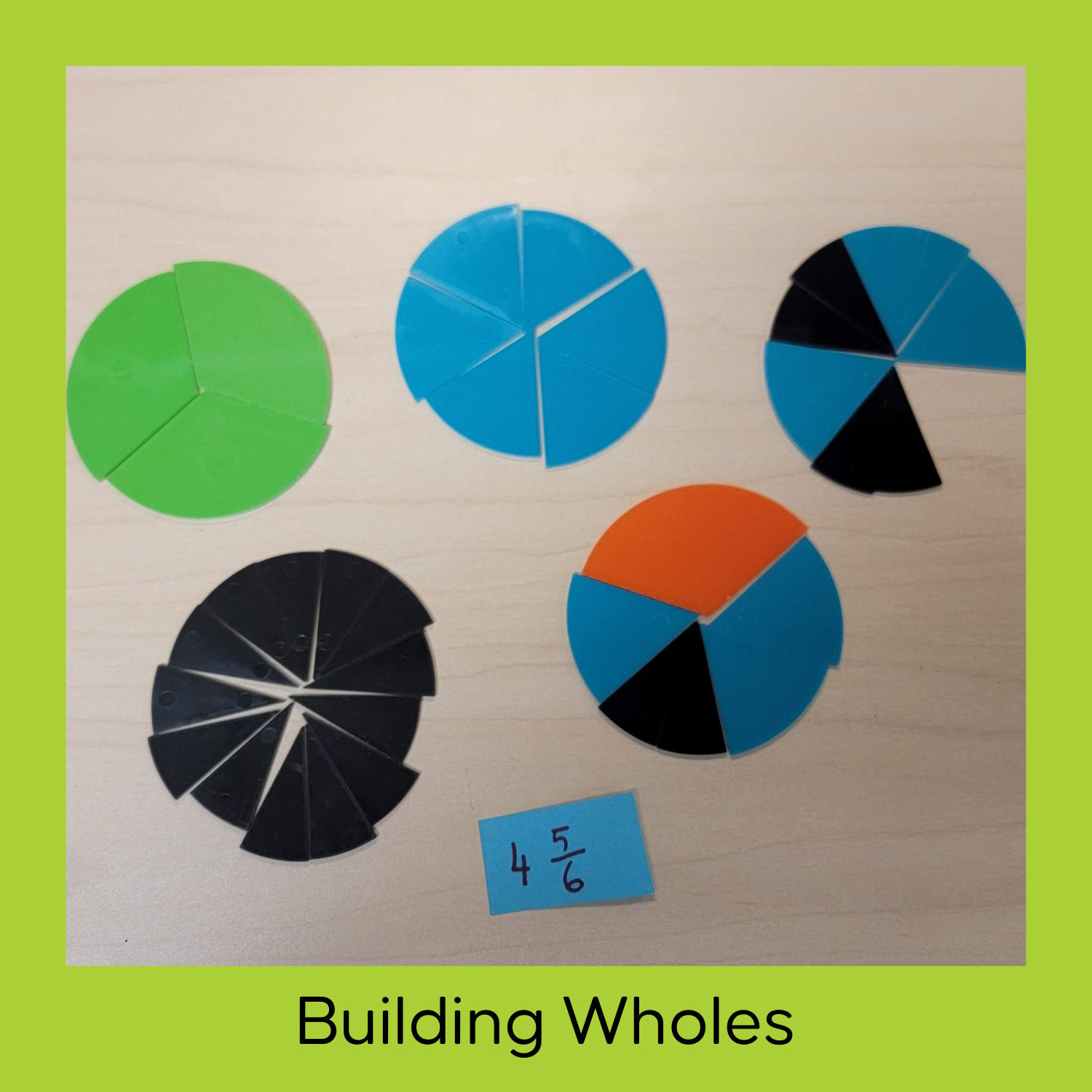
Another group might choose to make wholes as they organize the quantities. For example, students might compose four wholes and recognize that the remaining pieces were just one-sixth short of making a fifth whole, leading them to conclude that the collection represents four and five-sixths.
And yet another group might focus on making as many thirds as possible and initially express the total in terms of thirds with some pieces left over. Using symbolic reasoning supported by the visual relationships among thirds, sixths, and twelfths, students may then determine the final total using a single unit.
Single-Unit Collections
Another form of engagement for students is to work with collections made up of only one type of unit. They are then asked to determine—or imagine— what the whole would look like based on the subunit they are using. Some collections naturally make the whole and subunits obvious, such as fraction circles. Other collections, like inch tiles or Cuisenaire rods, offer more flexibility in defining subunits and wholes.
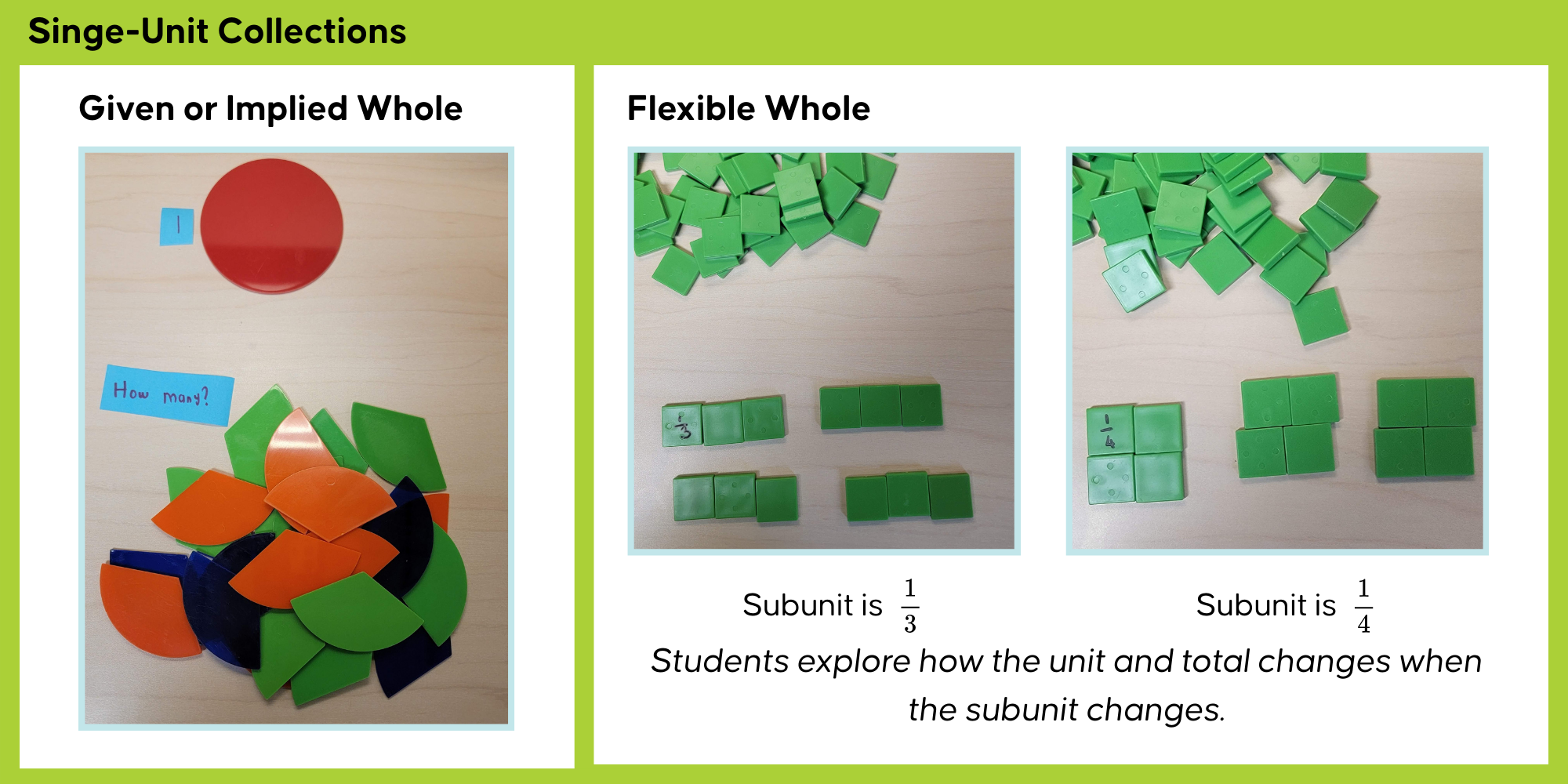
When students work with single-unit collections, they can explore how the choice of unit affects their count. For instance, when counting fraction circle pieces, students may first count pieces as individual parts, then realize that arranging them into wholes (e.g., each piece as one-third) changes their understanding of quantity. Similarly, when different groups count the same set of tiles using one-fourth or one-third as the unit, comparing results helps students see how the total “whole” depends on the size of the unit, deepening their understanding of fractions.
There are various ways teachers can engage students in this single-unit collection activity:
- Students are freely allowed to choose the unit or subunit.
- Students select the size of the subunit from a limited set of unit fractions, focusing on those appropriate for their grade level.
- The subunit is randomly assigned using a customized die or spinner.
- Students perform multiple iterations of counting the same collection, using a different assigned subunit each time.
- Example: Count the collection assigning halves as the subunit, record the answer, then count again assigning thirds as the subunit. Compare results to explore how the choice of subunit changes the whole, the number of units, and the size of the fractional parts.
- Assign each group a specific subunit to count their collection (e.g., one group uses thirds, another uses fourths). Compare the groups' work during classroom discourse.
These activities support deeper conversations about part-whole relationships and quantity reasoning.
Consideration of Materials for Thinking Flexibly About Numbers
- Redefine the whole in flexible ways: Use materials that allow students to explore how the value of a whole can change depending on the unit (e.g., pattern blocks).
- Explore relationships between units along a length: Provide linear models that help students visualize and compare unit sizes and build number sense (e.g., Cuisenaire rods).
- Encourage flexible thinking about fractional parts: Allow students to work with a fixed sub-unit (such as only halves or thirds) or a variety of sub-units to promote renaming, combining, and comparing (e.g., fraction circles).
Using a Recording Sheet
A recording sheet can be a powerful tool in Counting Collections with fractions because it gives students space to pause, reflect, and make their thinking visible. As students move beyond simply counting, the sheet can guide them to represent their ideas in multiple ways—using words to describe part–whole relationships, visuals to show how the pieces fit together, and symbols to capture fractional amounts.
This coordination of different forms of representations not only supports students in formalizing their reasoning but also helps them see connections across fractions in physical, visual, and symbolic forms. Over time, recording sheets can serve as a bridge between students’ informal counting strategies and more formal mathematical language and notation.
Let's examine different recording sheets completed by students.
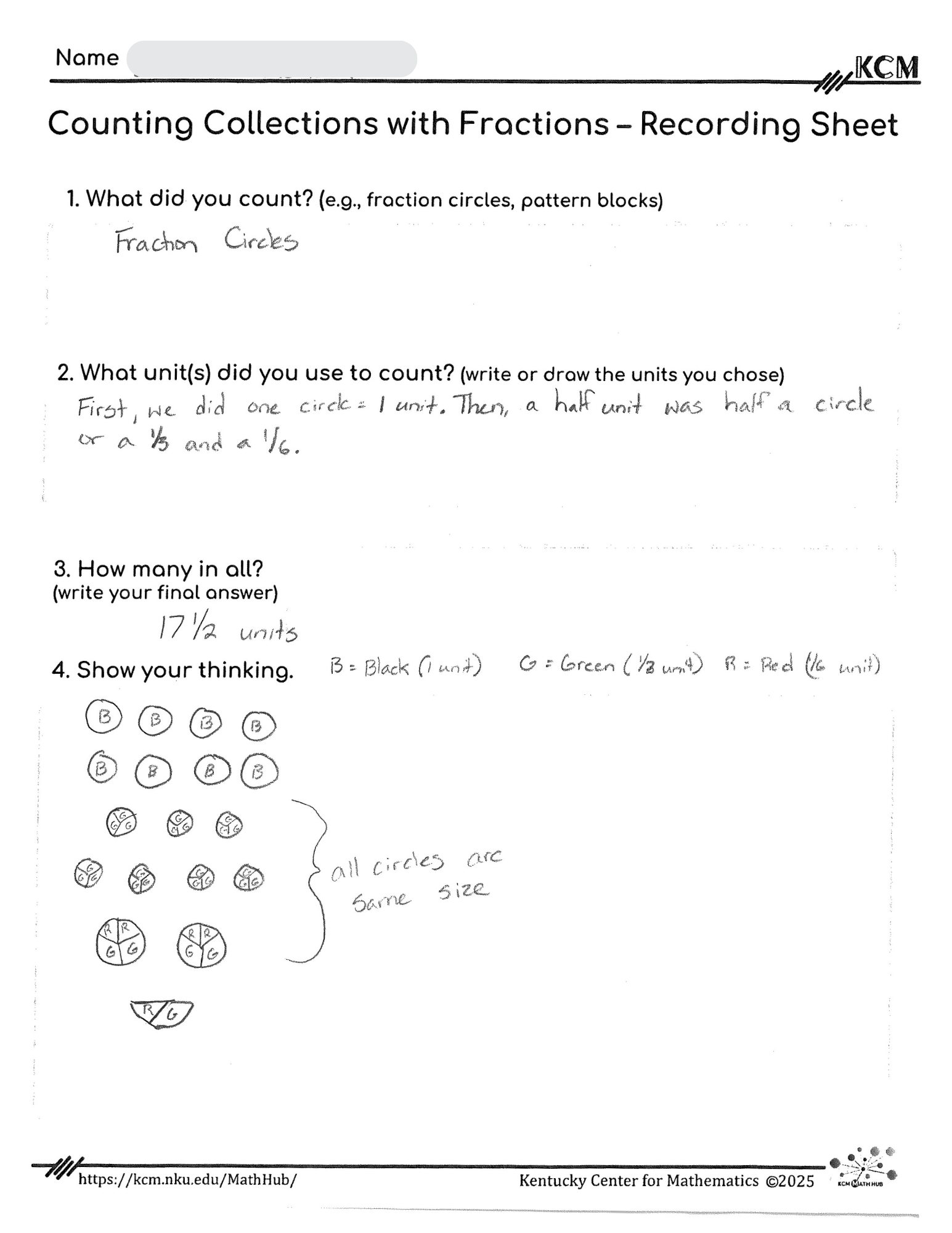
In this example, a student used fraction circles for her counting collection, which included wholes, thirds, and sixths. The activity was done as a group, but each student completed their own recording sheet. In this example, the student drew and labeled each piece in the collection to represent her thinking.
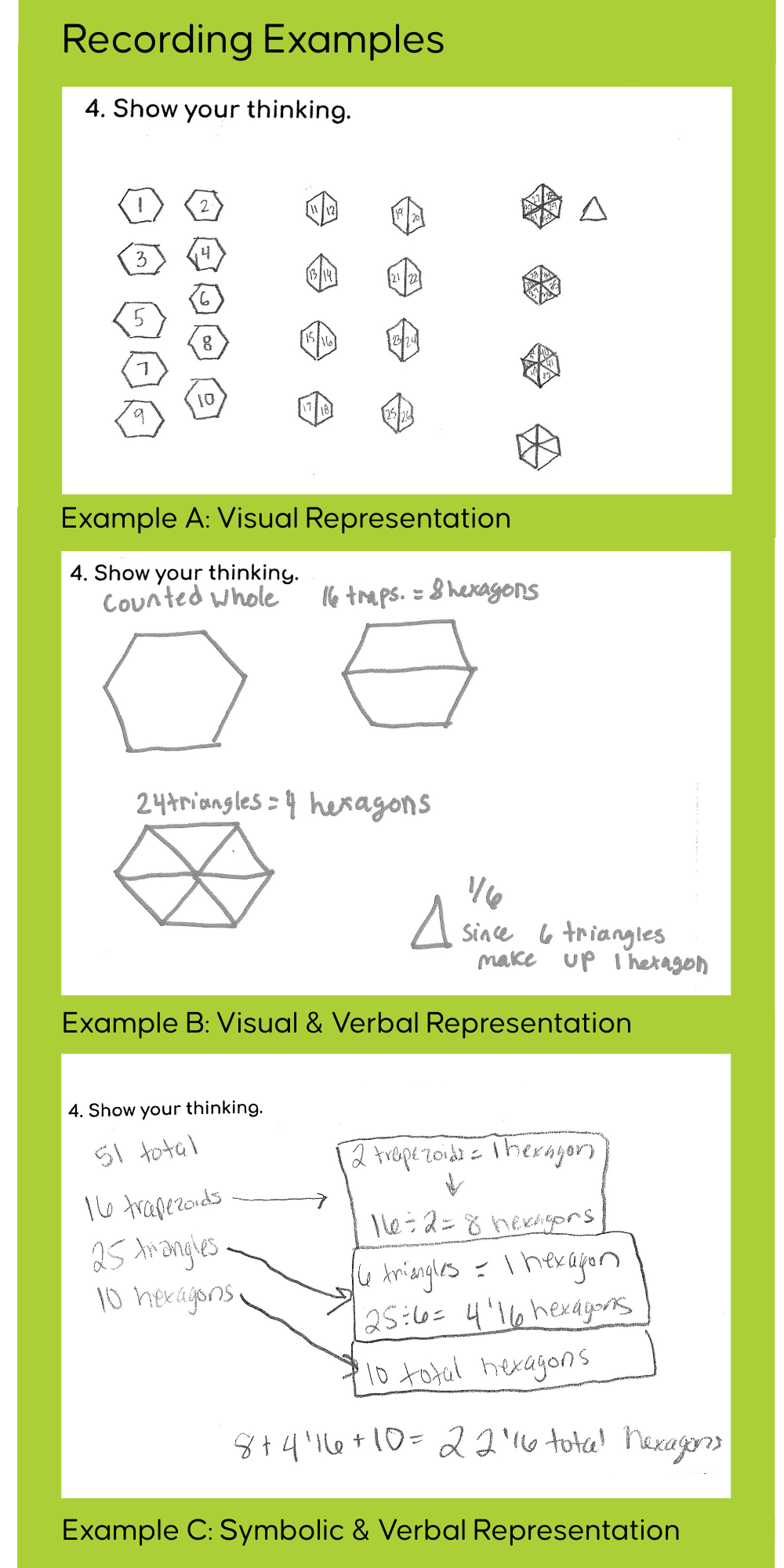
Let’s look at three different recording sheets where students represented their thinking in different ways. Each student was given the same amount of pattern block collection with hexagons, trapezoids, rhombuses, and triangles.
Example A shows a visual approach: the student drew the entire collection and labeled each piece to represent her thinking.
Example B combines words and visuals. Instead of drawing the full collection, the student described her units by sketching and showing how each subunit related to the whole. The total quantity is not shown here, since she had already recorded it in the “How Many” section of the sheet.
Example C uses words and symbols. This student explained the units and subunits and recorded how many came from each smaller collection. Her work ends with symbolic notation that shows how she combined all the units to reach the total.
Final Thought: Let Students Lead
When we ask, “How many?” and let students define units, compare methods, and shift their perspective of the whole, we open the door to deeper mathematical reasoning. Counting collections with fractions encourages creativity, curiosity, and a much richer understanding of numbers.
So next time you're planning a counting activity, don’t stop at whole numbers. Invite your students to count in parts.
Resources
- Franke, M. L., Kazemi, E., & Chan Turrou, A. (2018). Choral Counting & Counting Collections: Transforming the PreK-5 math classroom. Routledge.

