Counting Collections: Implementing a Counting Station in a Third-Grade Classroom
By Bethany Neel
 Counting is an important and worthwhile activity in the early grades and beyond. Counting
Collections, as described in Choral Counting and Counting Collections (Franke et al, 2018)
is a
counting routine in which students organize and count a collection of items and then share or record
their counting and organizational strategies. To learn more about the routine, visit the resources
and explorations linked at the end of this post. In this post, learn more about how one third-grade
classroom implemented a Counting Station to count a large collection of items.
Counting is an important and worthwhile activity in the early grades and beyond. Counting
Collections, as described in Choral Counting and Counting Collections (Franke et al, 2018)
is a
counting routine in which students organize and count a collection of items and then share or record
their counting and organizational strategies. To learn more about the routine, visit the resources
and explorations linked at the end of this post. In this post, learn more about how one third-grade
classroom implemented a Counting Station to count a large collection of items.
Setting up the Counting Station
My third-grade class has enjoyed a variety of experiences with counting this year, always in search of patterns and connections. They have practiced counting by ones, tens, and hundreds, forward and backward, from a variety of numbers, supporting their fluency and place value learning. Skip counting by other numbers has supported their developing multiplicative thinking, and I am looking forward to counting by fractional parts. We recently worked together as a class to count a large collection of erasers (we had 1,049!) I wanted to continue to give students concrete experiences with large numbers through counting collections. So I set up a counting station with a giant container of buttons and we set to work.
I told my students that our job was to find out how many buttons, but that we couldn’t spend class time counting them together. I wanted us to set up an area where someone could count when they had a few minutes, and then another person would be able to come and pick up where they left off. I left it up to the class to come up with a system. They asked if they could use some portion cups that we had used for other purposes in class, and decided that they would put ten buttons in each cup. We set up a desk in the back of the room with buttons and cups.
Engaging in the Routine
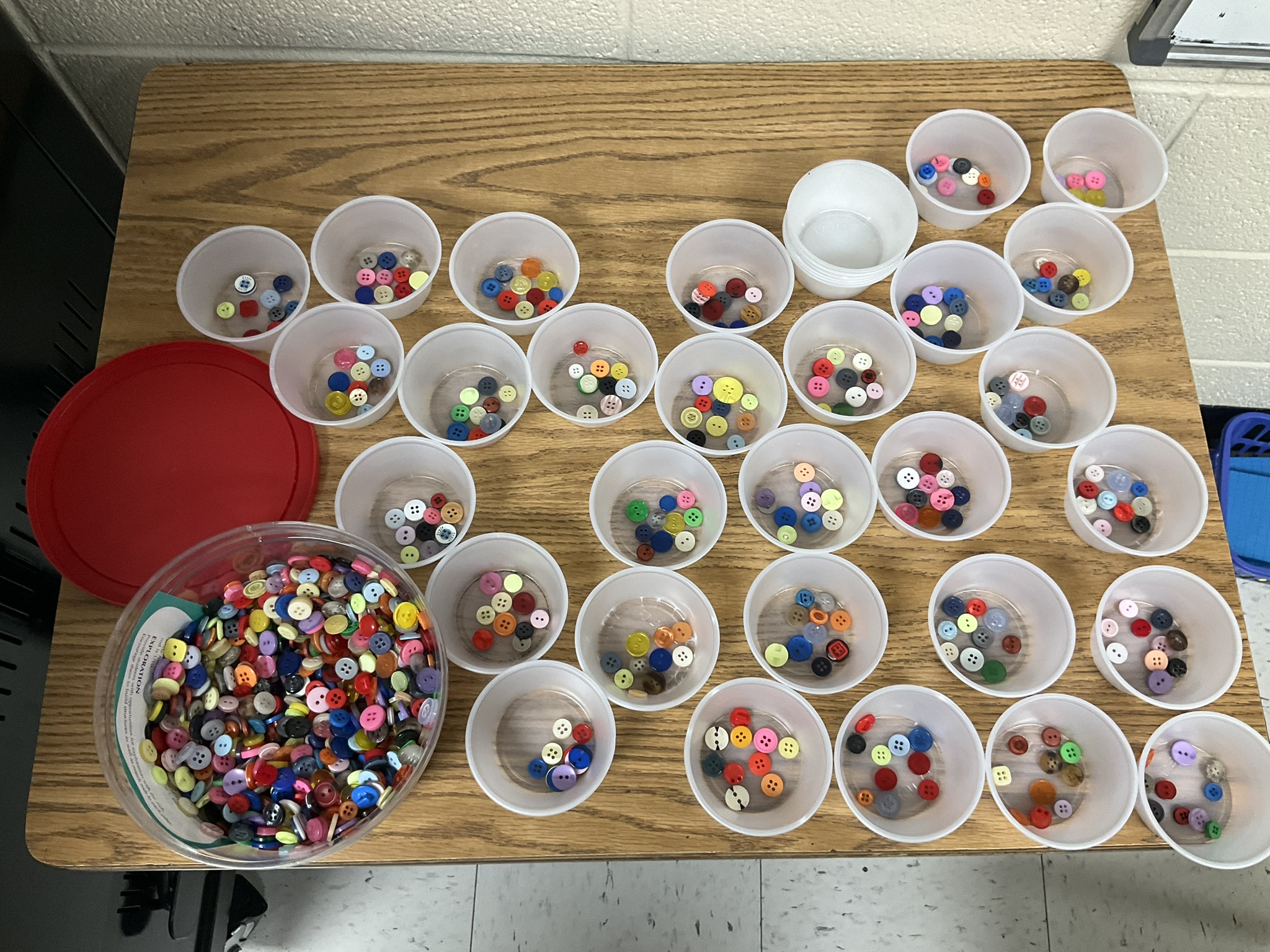
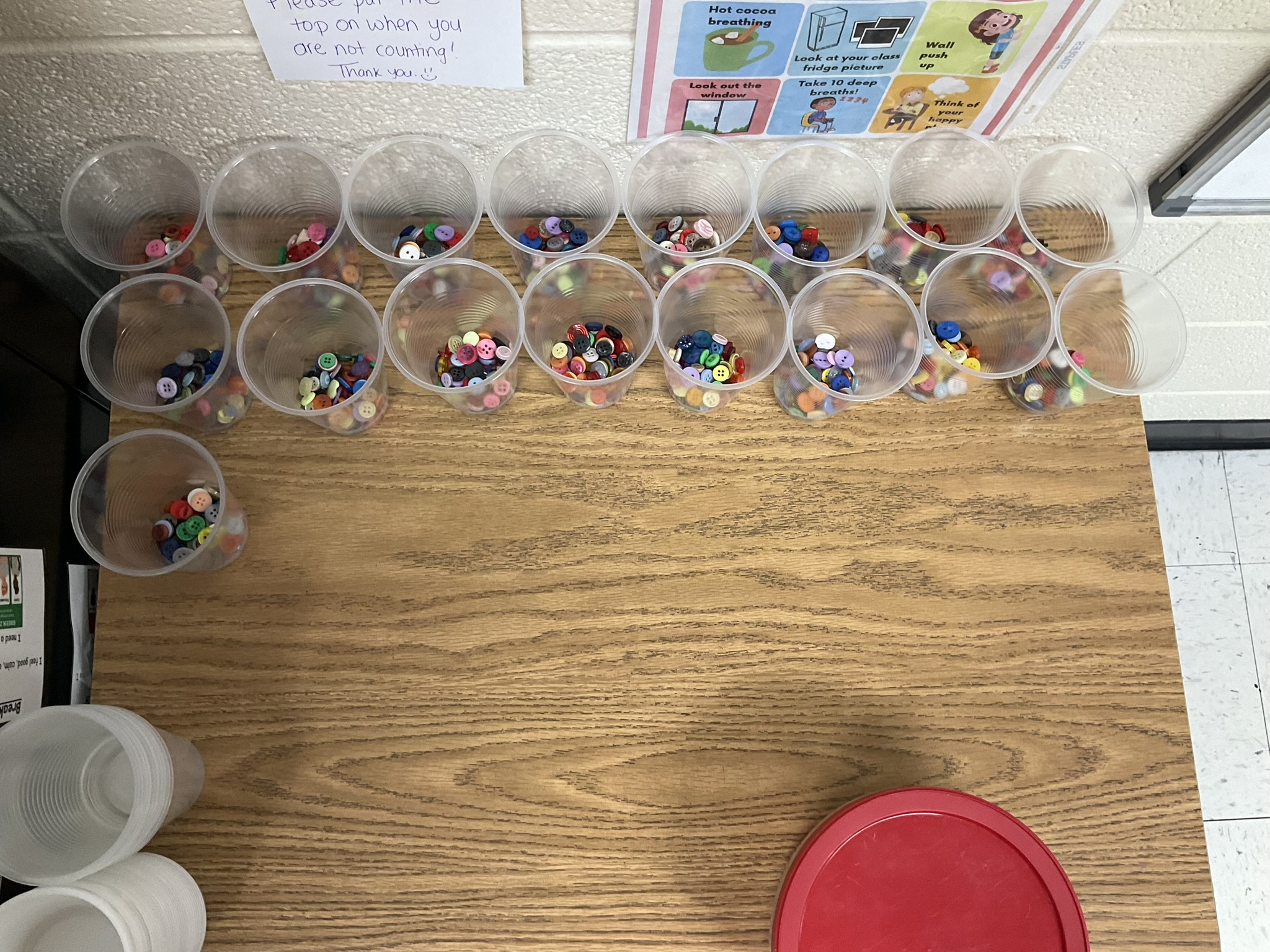
After about a day of students counting as they had time, the desk was full of cups of ten. Someone brought up that they thought we were running out of room for those small cups and that the buttons would end up on the floor and need to be counted again. They asked for larger cups and decided they would fill up ten small cups with ten and then dump 100 buttons into the large cups. I put out a few large cups and the count continued. Every day or so, the students would update me on how many cups they had filled, and they were especially excited when they reached 1,000.
When students had a few minutes throughout the day, they would sit down to count. It was interesting to see which students chose to count buttons. Sometimes it was a student who was feeling frustrated and would take a quick break to calmly count buttons, or an active student needing a quiet moment. Other times, it was several students working together and talking about their process, the current count of buttons, and their evolving estimates of the total number of buttons. My students were beginning to learn about multiplication, and I heard students making connections between place value and multiplication. The cups were often arranged in arrays, students were talking about how many groups of 100 they had counted and even writing multiplication equations with groups of 10 and 100 on nearby whiteboards.
Finding Joy and Agency
One morning, I was in the hallway greeting students as they arrived. One of my students excitedly came to tell me that they thought we were almost finished counting buttons. I came to the counting station to get the updated total, 17 cups of 100, which they told me was 1,700. I asked if they thought we would get to 2,000 and heard some interesting estimates. I stepped back into the hallway, and a few moments later, there was an eruption of noise from my classroom, the kind that also got the attention of the teacher across the hall. She rushed in my room to find that all the commotion was that they had, in fact, reached 2,000 buttons. The joy and excitement on their faces as they told her about how they had organized and counted their buttons was amazing. We had a debriefing discussion about how many groups of one hundred they had created and how many ten cups it would have taken to count all of those buttons. They were making connections between their understanding of place value and multiplication.
Since then, when my students see a large collection of something in our classroom, it seems to end up at the counting station. They have worked together to organize and refine their counting process. They are asking for an even larger collection to count, and I can’t wait to see how they will choose to organize their counting this time!
This counting station has allowed my students to practice counting, find efficient processes, and experience the magnitude of larger numbers. They have taken ownership over this classroom routine, and are making amazing mathematical connections.
Resources
- Franke, M. L., Kazemi, E., & Chan Turrou, A. (2018). Choral Counting & Counting Collections: Transforming the PreK-5 math classroom . Routledge.
- Counting Collections Overview (Development and Research in Early Math Education at Stanford)
