Problem Strings
By Dee Crescitelli
 A problem string is a
sequence of related arithmetic tasks (typically 5-10 problems presented horizontally) that are designed to call
attention to a particular mathematical strategy or feature. They can be posed with materials, such as showing an
addition problem on a double bead rack, or posed with just numerals. Each task is presented one at a time. Often,
the previous tasks and their solutions remain visible as each successive task is presented.
A problem string is a
sequence of related arithmetic tasks (typically 5-10 problems presented horizontally) that are designed to call
attention to a particular mathematical strategy or feature. They can be posed with materials, such as showing an
addition problem on a double bead rack, or posed with just numerals. Each task is presented one at a time. Often,
the previous tasks and their solutions remain visible as each successive task is presented.
Problem strings create opportunities for students to discover and strengthen their computational strategies and foster number sense. The types of tasks and the way successive problems build on each other determine which strategies students will discover and use. Teacher questioning, student think time, and student discussions are critical to the process.
Problem strings can be a powerful tool for supporting math talk in the classroom. After posing the problem, give plenty of wait time and prompt students to explain their thinking. Invite them to find and use a variety of strategies.
Using the Strings to Foster Student Thinking
Use open-ended questions to prompt student thinking, such as:
- How did you work that out?
- Why does that work?
- Does anyone have another way to work that out?
- What did you know that helped you work that out?
- Do you see a pattern? What is it?
- What is a new problem that is similar to these?
- Can you use the previous problem(s) to help with this problem?
These types of questions help to foster student sense-making and the development of more advanced strategies. The teacher's role is to keep the mathematical discussion focused, help students express and record their own thinking, and support students in listening to and understanding one another. Be careful not to show a "teacher" way of solving or thinking - this will discourage students from pursuing their own ideas and listening to peers. Be open - students may come up with ideas you did not anticipate, but that contain beautiful mathematics!
Planning to Lead a Problem String
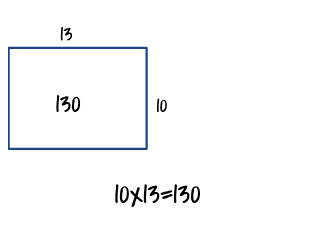
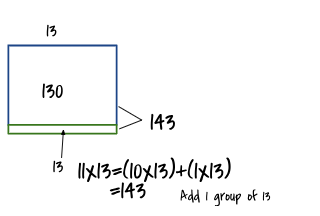
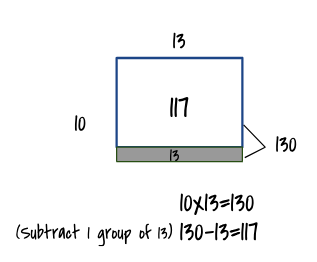
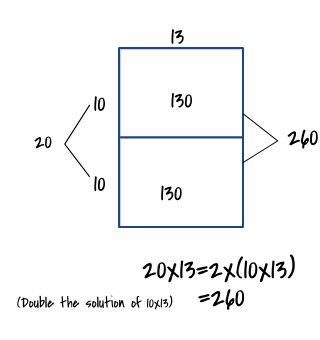
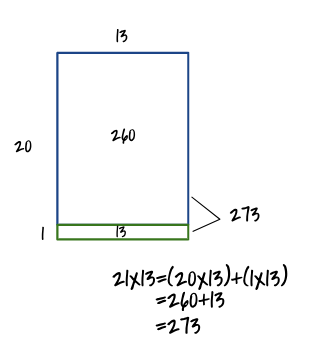
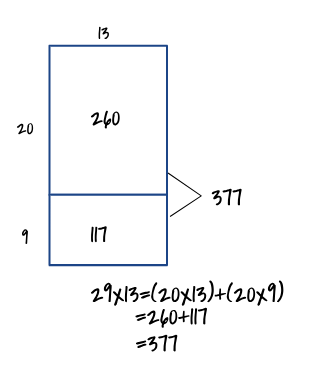
It is helpful to spend some time planning the questions you want to use for the specific problem string you are facilitating. I often sketch out both possible questions and representations I want to use while leading discussions of the problems. Here is an example of a problem string that lends itself to open array representations and uses a 'helper problem' structure. A helper problem is one with a solution attainable by most students, and that can be used by students to help them solve at least one other problem in the string.
| Prompt | Possible Questions | Representations |
|---|---|---|
| 10 x 13 | What is 10 x 3? What would a rectangle that is 10 by 13 look like? |
 |
| 11 x 13 | What is 11 times 13? How do you work that out? Did you use our previous problem to help you? How might we represent this as an array? |
 |
| 9 x 13 | What is 9 x 13? How might you use a previous problem to help you? (Students often subtract a group of 13 from the solution to 10 x 13.) How did you think about subtracting 13 from 130? |
 |
| 20 x 13 | What is 20 x 13? How might you use previous problems to help you? (Students often double the solution for 10 x 13.) What would a 20 by 13 rectangle look like? |
 |
| 21 x 13 | What is 21 x 13? What is the area of a 21 by 13 rectangle? What previous problem did you use to help you? (Many students add one group of 13 to the total for 20 x 13.) |
 |
| 29 x 13 | What is 29 x 13? What previous problems might be helpful in working out this one? (Students may add the solutions for 20 x 13 and 9 x 13.) |
 |
Problem strings are a great routine for helping students make important connections and see numeric relationships and mathematical properties in action. Annotating the problem string makes student thinking visible while highlighting strategies, models, and concepts needed in building number sense and computational fluency.
Resources
To learn more about Problem Strings, we recommend:
- What are Problem Stings?
- Sample Problem Strings
- Problem Strings for Fluency and Beyond Series from Cathy Fosnot that includes problem strings for grades 1-5

