It’s Only Fair! Equal Sharing as a Path to Fraction Sense
By Funda Gonulate (Northern Kentucky University)
 What does it really mean to share something? What does “fair” look like in mathematics?
These
questions start in the early grades and continue to shape meaningful mathematical thinking at every
level.
What does it really mean to share something? What does “fair” look like in mathematics?
These
questions start in the early grades and continue to shape meaningful mathematical thinking at every
level.
The Equal Sharing Routine is a powerful, flexible instructional routine that supports students in making sense of division and fractions at any grade level. Rooted in ideas from Cognitively Guided Instruction (Empson & Levi, 2011), this routine invites students to use their intuitive understanding of fairness to develop a mathematical definition and meaning as it relates to equal partitioning and division. When implemented thoughtfully and consistently, equal sharing serves as a rich space for reasoning and building a foundational understanding for fractions.
In this post, we'll explore what the Equal Sharing Routine looks like, how it works instructionally, and why it helps students build meaningful understanding of fractions and division, with examples across grade levels.
A Classroom Example
We can use children's literature to spark interest and provide meaningful contexts for exploring equal-sharing problems. One example is Cookie Fiasco by Dan Santat, a story that highlights both fair and unfair sharing situations. In the video above, a teacher uses this book to engage students in figuring out how to share cookies fairly. As you watch the video, consider the mathematical ideas students explore through this story and how using a story as context can spark curiosity and interest in learning.
What is the Equal Sharing Instructional Routine?
The Equal Sharing Routine involves presenting students with a scenario in which a quantity is shared equally among a group of people.
An equal sharing problem typically involves:
- A total quantity (e.g. 5 cookies)
- A number of recipients (e.g. 3 children)
- The question: How much does each person get if the cookies are shared equally?
It might seem very simple on the surface:
“Three friends share five cookies equally. How much does each person get?”
The power of this task comes from using it to build understanding of key fraction concepts and their connection to division, not just to find an answer.
Here’s how the routine typically unfolds:
- Pose the Problem - Present a real-world equal sharing context with numbers (grade- appropriate) that promotes discussion.
- Think Time - Students solve using drawings, manipulatives, or expressions and equations.
- Might include a partner or small group discussion - Students share methods, compare reasoning, and refine their thinking.
- Whole-Class Share - A few students share strategies. The teacher selects and sequences responses to highlight mathematical ideas.
- Naming & Formalizing - The teacher (and peers) help connect representations to grade-appropriate fraction language and notation.
These tasks help students build flexible understandings of numbers and operations while encouraging reasoning, discourse, and visual modeling.
Equal Sharing Problem Examples
Primary Grades (K-2): Foundational Fraction Ideas
Sample tasks:
- 3 brownies are shared equally among 2 children. How much does each child get?
- 4 children share 2 sandwiches equally. How much does each child get?
Grades K and 1 should focus on sharing between 2 or 4 people, and sharing among 3 people can be introduced once students are at Grade 2.
Students might fold paper brownies (or sandwiches, etc.), draw pictures, or use play food to divide each sandwich into fourths. They might say, “Each child gets half of a sandwich,” and then realize they can break those halves again if needed.
Let's consider the scenario presented in the Cookie Fiasco: 4 animals want to share 3 cookies fairly. Students might use paper cookies and small counters to represent the situation.
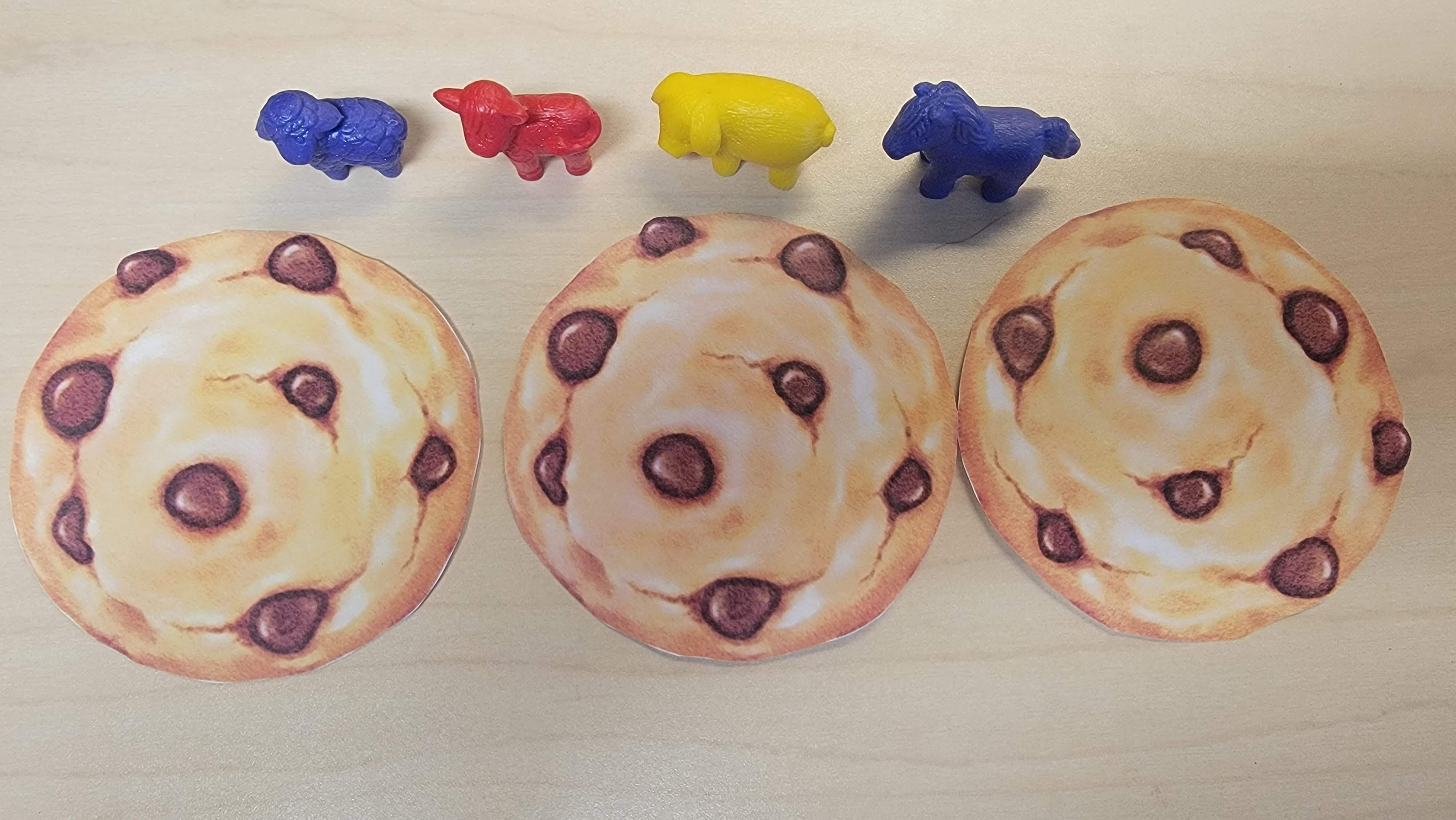
Students might explore this situation in different ways. For example, a student might start by giving each animal half of a cookie, but they would notice that one whole cookie remains. The student might then cut the remaining cookie into smaller pieces—in this case fourths—so each animal receives a half and a fourth of a cookie.
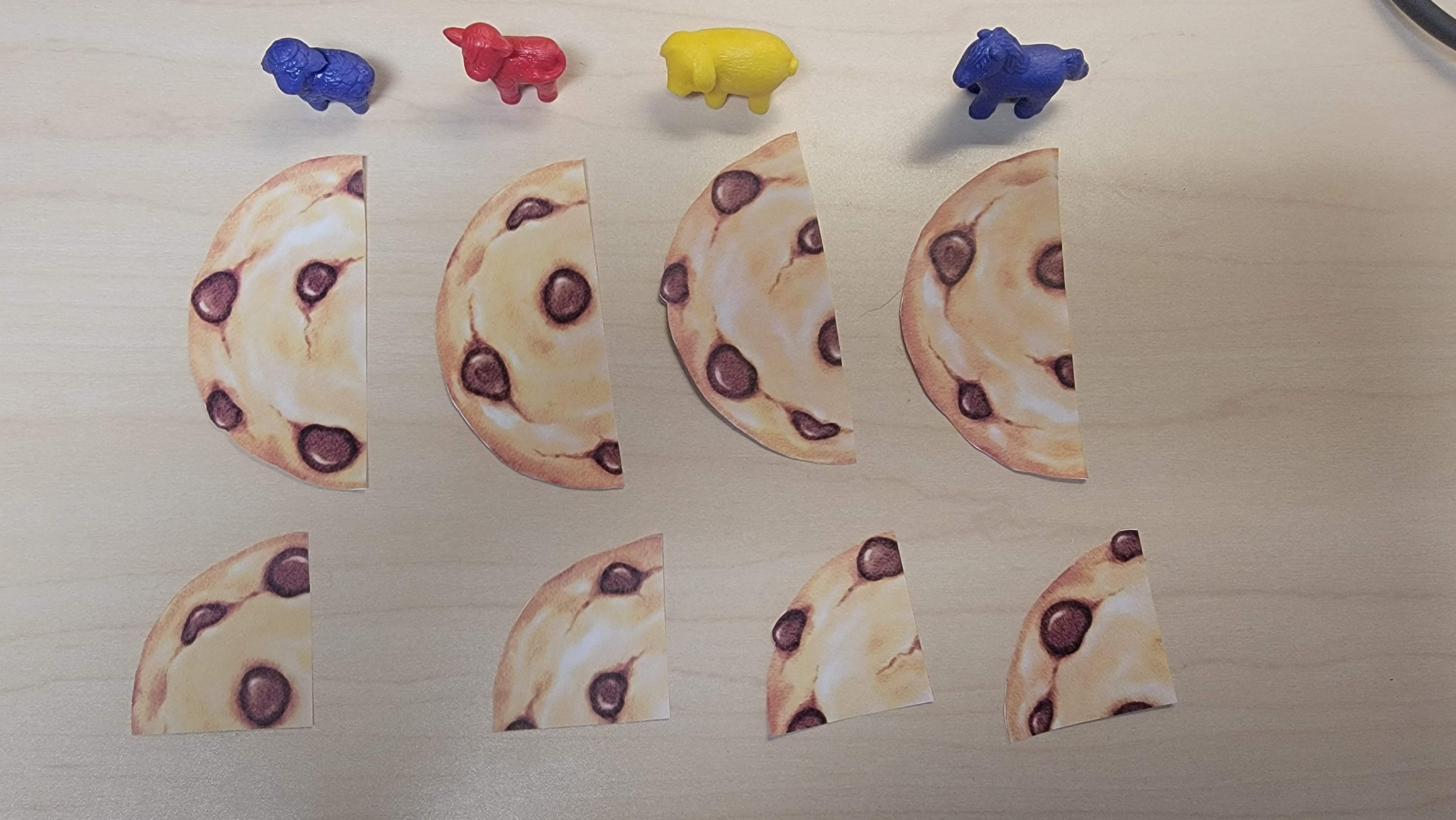
Another student might start by cutting the first cookie into four equal pieces and distributing one piece to each animal. They continue this approach for each cookie, ultimately giving each animal 3 pieces. This allows them to count using fourths as the unit, noticing that each animal would receive 3-fourths of a cookie.
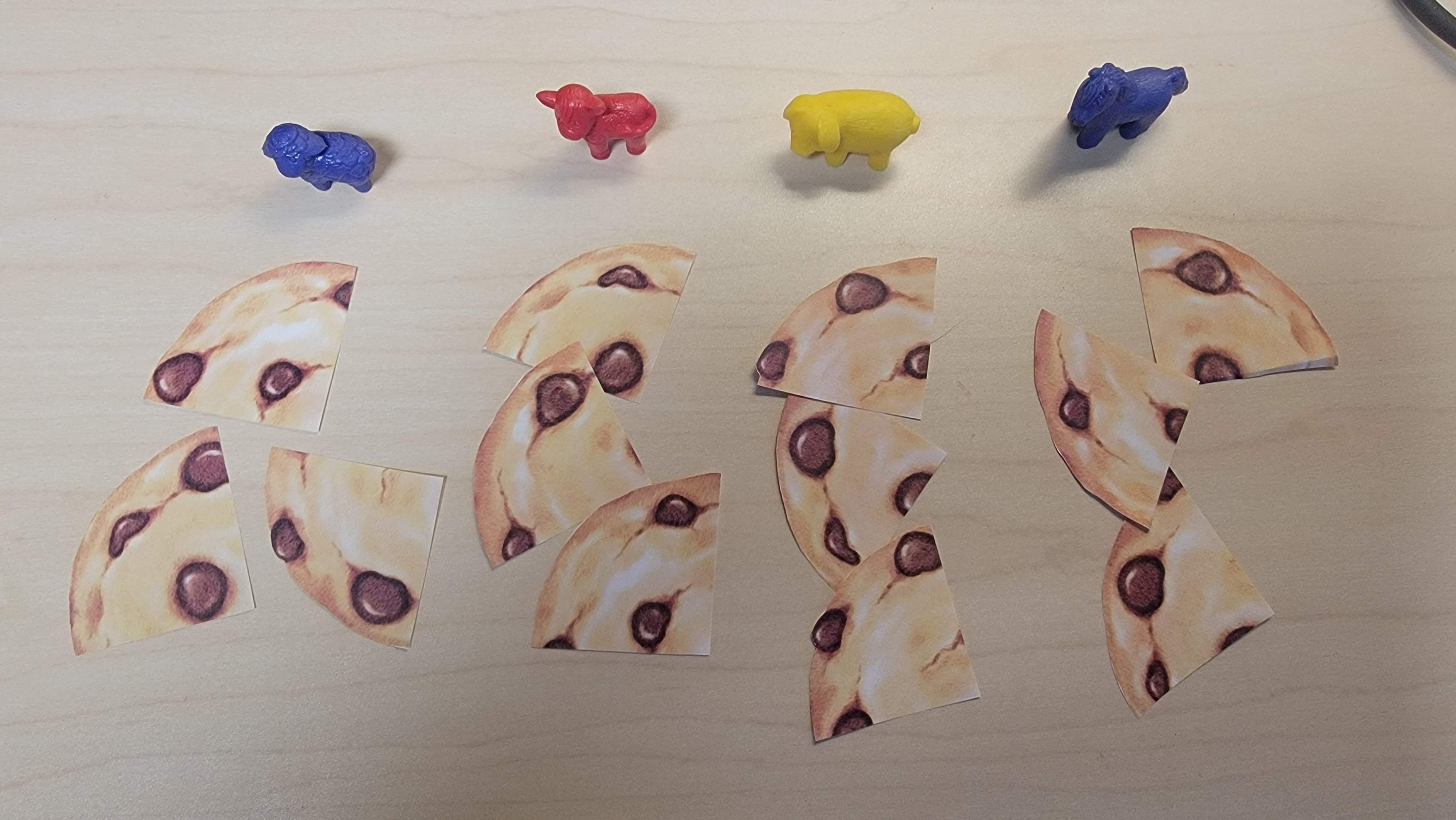
In the primary grades, the emphasis is on describing shares using words and visuals rather than symbols. Students are encouraged to use terms like halves, thirds, and fourths (or quarters) to explain the size of the pieces being shared, and it’s important to connect those verbal descriptions to visual representations. The focus should also be on the act of partitioning equally, as young learners need to develop the ability to partition shapes or sets into equal parts.
This is why it's best to keep the problems simple—such as sharing with 2, 3, or 4 people—and to avoid modeling for students or requiring specific strategies such as “I need you to partition each piece into halves”. Students should feel free to create their own representations. Mistakes are welcome at this stage, as the goal is to build a foundational understanding of fairness. For example, it's a normal starting point if a child says, “I'll get one cookie, and my friends can share the other one.” However, following with a question, “Yes, but is it really fair?” will prompt them to think deeper about fair sharing situations and have children consider fractional pieces.
Learning Goals:
- Using the words “halves”, “fourths”, “quarters” (and “thirds” for second graders) to name unit fractions
- Developing fair-sharing strategies and comparing fair and unfair shares
- Recognizing that shares might look different but might still be fair (different-looking halves or fourths)
Intermediate Grades (3-5): Naming, Equivalencies, and Formalization
Sample tasks:
- 5 friends share 3 pizzas. How much does each person get?
- 3 children share 4 candy bars equally. How much does each child get?
In the upper grades, students explore a wider range of divisors (i.e. the number of people with whom items are being shared) beyond familiar numbers like 2, 3, and 4, and they encounter sharing situations where each share exceeds one whole.
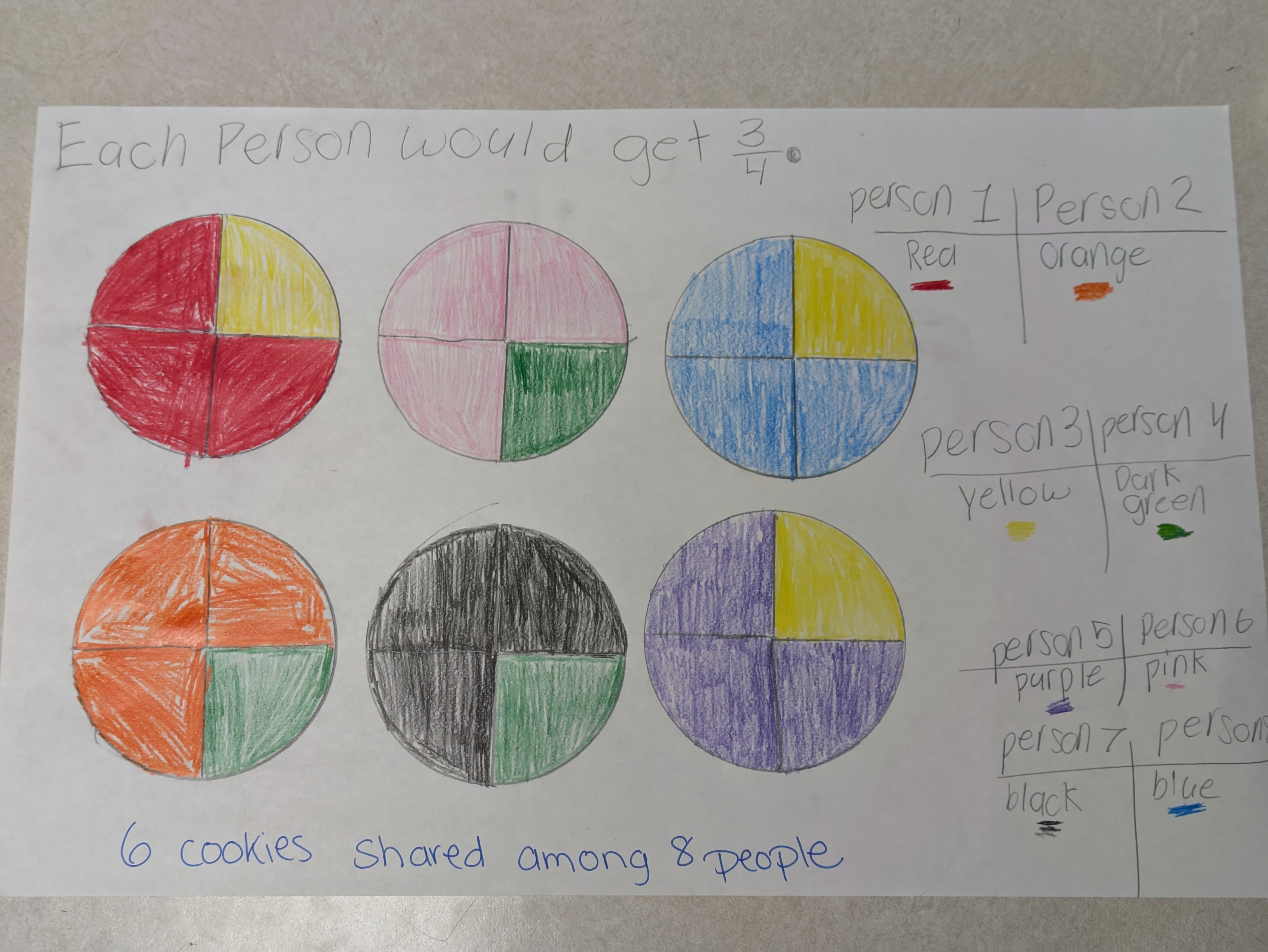
As students engage with these equal-sharing scenarios repeatedly, they are encouraged to use visual representations, label each part, and clearly state how much each person receives. This focused exploration helps students connect visual models with verbal explanations, symbols, and real-world contexts, leading to a much stronger understanding of fractions. Fair-sharing activities with intentional classroom discourse help make fractional relationships visible, allowing students to see why 12 is larger than 14 and that 12 is the same as 24. By the time students reach Grade 5, they are ready to make formal connections between fractions and division. They begin to represent equal sharing problems using both division expressions and fraction notation, for example, recognizing that “3 ÷ 5” is equivalent to the fraction “35”.
Learning Goals:
- Introduce symbolic notation and connect to primary foundations (e.g., shifting from "half" to 12)
- Introduce unit fractions formally with symbols, words, and visuals, and compare unit fractions (understanding that a larger denominator means smaller-sized pieces)
- Recognize and describe fractions as composed of unit fractions (e.g. 35 = 15 + 15 + 15)
- Make connections of fractions between multiple representations (context, words, visuals, symbols)
- Opportunities to notice and create equivalent fractions and compare fractions (e.g. 68 = 34, 34 > 38 )
- Connect division and fractions (e.g., 3 ÷ 5 = 35)
Final Thoughts
By making equal sharing a regular instructional routine, we help students build a strong conceptual basis for making sense of fractions:
- Encourages students to use a variety of visual representations and contexts to identify and compare fractional parts.
- Emphasizes that fractions are connected to division
As a start, you might consider starting with this simple question:
How can we share this fairly?
Resources
- Extending Children's Mathematics: Fractions & Decimals by Susan B. Empson and Linda Levi (2011)
- Developing Fraction Concepts through Equal Sharing Problems: Blog post about beginning fraction instruction with fair share problems
- Early Strategies for Equal Sharing Problems: Blog post that highlights student strategies for solving fair share problems
- The Cookie Fiasco by Dan Santat and Mo Willems
