Change of Period in Trigonometric FunctionsObjectivesAfter completing this lesson, you should be able to:
IntroductionDuring previous lessons, we observed that trigonometric functions presint a special characteristic, which is its periodcity. This characteristic makes it possible that with it, we can model a great variety of real-life applications. For example, waves describe the periodic change in sea level. The graph for modelling this phenomenon is as follows: We can guess that this variation can be modeled using the sine function. However, we need to adjust the period in the function in order to represint the real function of this phenomenon. In other words, it is necessary for the period of the function to be within 24 hours. In this lesson, we will study the transformations which make it possible to change the period of trigonometric functions and to recognize the period of the transformed functions. Change of PeriodRemember the period of functions sin(x) y cos(x) is 2π. Let's analyze how this period changes in the following examples: Example 1: Graph and identify the period of function
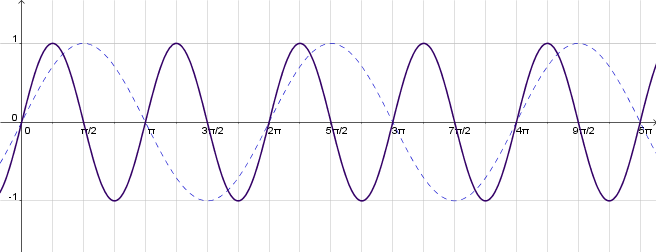
The figure shows the graph of function sin(2x). Additionally, it shows the graph of function sin(x) in dotted lines. By observing the graph, it is clear the graph for period sin(2x) is π. Note the periodic change has a relationship with value 2 which multiplies the variable x, so by duplicating the entry, the period is reduced by half. Example 2: Graph and identify the period of function
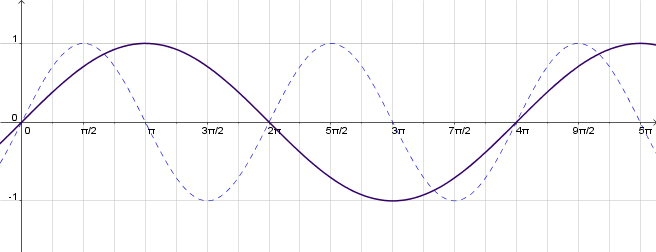
The figure shows the graph of function sin(2x). Additionally it shows the graph of function sin(x) in dotted lines. By observing the graph, it is clear the period for sin(x/2) is 4π Example 3: Graph and identify the period of function
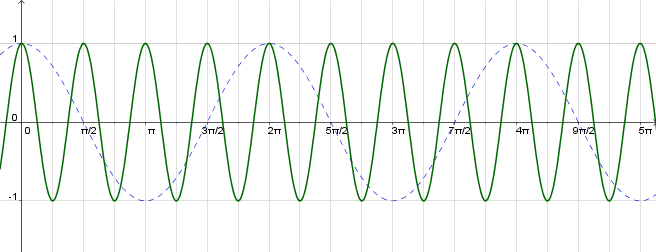
The figure shows the graph of function cos (4x). Additionally, it shows the graph of function cos(x) in dotted lines. By observing the graph, it is clear that the graph of the period for cos(4x) is π/2 Example 4: Graph and identify the period for function
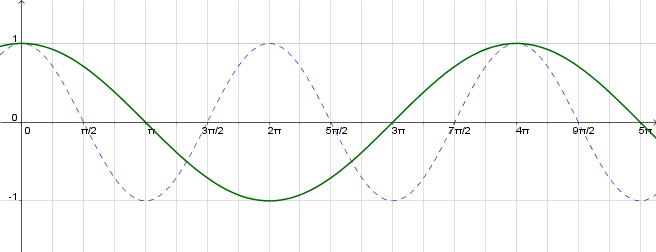
The figures shows the graph of function cos(2x). Additionally, it shows the graph of function cos(x) in dotted lines. By observing the graph it is clear that the period for cos(x/2) is 4π. Formula to find the PeriodWe know the period of function sin(x) is 2π, in other words, in a complete period x varies from 0 to 2π, in this way, if we multiply by a constant k, we obtain: We can prove this result by applying the formula with the previous examples, as shown in the following table:
To practice exercises about the period of trigonometric functions, click on the following button: SummaryNow that you have completed this lesson, you should be able to:
|